
We have seen many Pre Columbian sites in Peru. It is difficult to make overall sense of them, as the pre Columbian civilisations were small in size, and do not appeared to have conquered neighbours. None of them had a written language, so only the drawings on archeological sites are all that exists today. It is also obfuscated by many of the sites claiming to be the "oldest civilisation" , usually on spurious carbon dating grounds that have not been equally applied to all sites . What one can say though is that a number of civilisations existed in Peru well before the Incas.
What is Peru today, was inhabited 14,000 years ago by hunters and gatherers. Subsequent developments include the appearance of sedentary communities that developed agriculture and irrigation, and the emergence of complex socio-political hierarchies that created sophisticated civilizations, technology and monumental construction.
Larger, more complex societies formed around 3000 BC, and this is now known as the Cotton Preceramic Period. These early societies focused on the gathering of marine resources and did not rely on maize, as later civilizations did. Subsequent technical developments include innovations in spinning and knitting of cotton and wool. There is also evidence for some basketry, and metalwork (gold beads) during this period. The period that ensued is now called the Initial or Ceramic. Maize was adopted as a staple crop, creating population growth because of its high carrying capacity. The population distribution moved from the coasts to river valleys because of the growing importance of farming. Canal building and water management became important. They all seem to have used adobe brick pyramids to construct massive temples
Some of these cultures died out before the Incas invaded, but many survived only to be conquered by the Incas. From 1438 to 1533, the Incas incorporated a large portion of western South America, using both conquest and peaceful assimilation. At its largest, the Inca empire joined modern-day Peru with what are now western Ecuador, western and south-central Bolivia, northwest Argentina, the southwestern most tip of Colombia and a large portion of modern-day Chile, forming a state comparable to the historical empires of Eurasia. Its official language was Quechua.
1532 the Spanish began their conquest of the Inca Empire, and by 1572 the last Inca state was fully conquered by Spain
 |
Caral–Supe included as many as thirty major population centres in what is now the Caral region of north-central coastal Peru. The civilization flourished from 400 BC to 200 BC, with the formation of the first city generally dated to around 3500 BC. . This lasted until a period of decline around 1800 BC. Since the early 21st century, it has been recognized as the oldest-known civilization in the Americas, and as one of the six sites where civilization separately originated in the ancient world. |
 |
Chavin constructed as early as 1200 BC, and occupied until around 400–500 BC by the Chavín, a major pre-Inca culture |
 |
Cumbe Mayo The aqueduct and the petroglyphs at Cumbemayo are thought to be built circa 1500 - 1000 BC,, the petroglyphs being similar to those of Chavín culture |
 |
El Brujo The Lady of Cao was wrapped in a cotton funerary bundle with pieces of gold and jewellery, indicating her high status. Her grave contained numerous clubs and spears, which is unusual in Moche culture.She was buried about 450 AD. Moche culture |
 |
Huaca de Luna Moche civilisation. A large adobe brick structure built mainly by the Moche people of northern Peru. The Huaca del Sol was partially destroyed and looted by Spanish conquistadors in the seventeenth century, while the Huaca de la Luna was left relatively untouched. |
 |
Karajia The Sarcophagi of Karajía are unique in their genre for their large size, up to 2.50 m high, for their careful making, and, for the fact that they were remained practically intact because of their location atop a ravine of difficult access. They have been radiocarbon dated to the 15th century, coincident with the Inca conquest of the Chachapoya in the 1470s |
 |
Kuelap A citadel high in the mountains. The Chachapoyas, also called the "Warriors of the Clouds", was a culture of the Andes living in the cloud forests. The Inca Empire conquered their civilization shortly before the Spanish conquest in the 16th century. At the time of the arrival of the conquistadors, the Chachapoyas were one of the many nations ruled by the Incas, although their incorporation had been difficult due to their constant resistance to Inca troops. After the Spanish conquest, the Chachapoyas disappeared. And Kuelap was abandoned around 1600 |
 |
Laymebambe The museum has over 200 mummies. The Chachapoya used to bury their dead in a crouched position, inside wooden sarcophagi, then wrap the sarcophagus in cloth and sew a human face on the front. Despite the humidity of the area, and the activities of huaqueros, hundreds of mummies were discovered, with skin and even hair still intact. Seeing a room full of mummies is undoubtedly a highly-memorable museum experience |
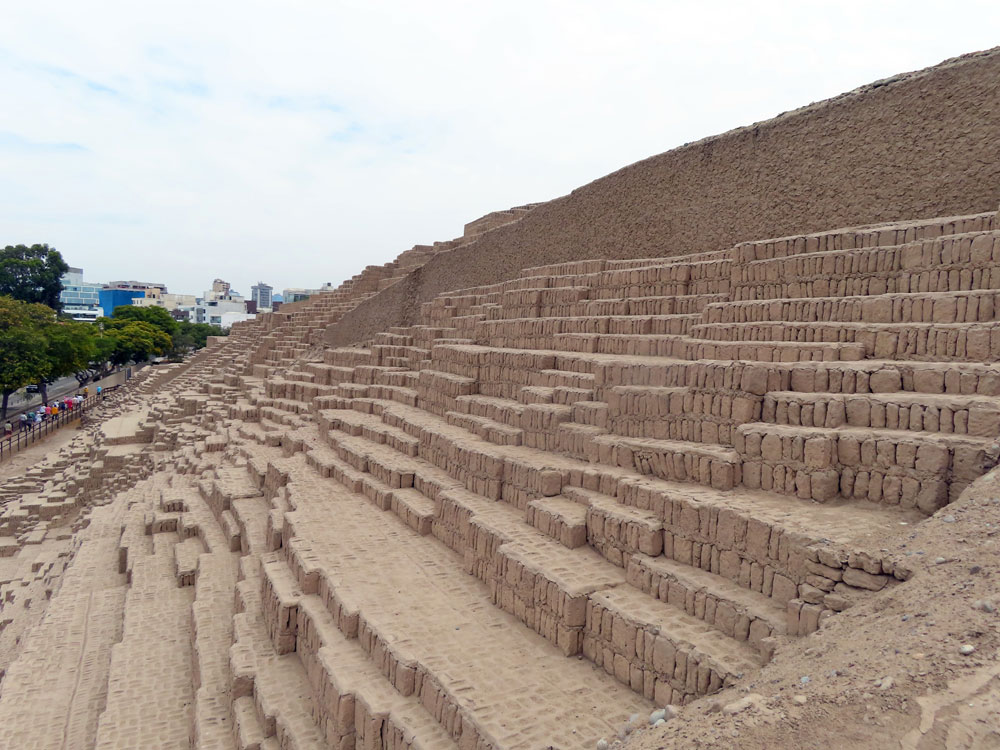 |
Lima Culture. Huaca Pucliana served as an important ceremonial and administrative centre for the advancement of the Lima Culture, a society which developed in the Peruvian Central Coast between the years of 200 AD and 700 AD. The Lima culture was a pre-Incan culture, which overlaps with surrounding Paracas, Moche, and Nasca civilizations, was located in the desert coastal strip of Peru. It can be difficult to differentiate the Lima culture from surrounding cultures due to both its physical proximity to other, and better documented cultures, in Coastal Peru, and because it is chronologically very close, if not over lapped, by these other cultures as well. |
 |
Moche Culture flourished in northern Peru with its capital near present-day Moche, Trujillo, from about 100 to 800 AD during the Regional Development Epoch. Many scholars contend that the Moche were not politically organized as a monolithic empire or state. Rather, they were likely a group of autonomous polities that shared a common culture, as seen in the rich iconography and monumental architecture that survives today. |
 |
Nazca Culture An archaeological culture that flourished from c. 100 BC to 800 AD beside the arid, southern coast of Peru . Strongly influenced by the preceding Paracas culture, which was known for extremely complex textiles, the Nazca produced an array of crafts and technologies such as ceramics, textiles, and geoglyphs. They are known for construction projects that would have required the coordination of large groups of labourers: the Nazca Lines, immense designs in the desert whose purpose is unknown, and puquios, underground aqueducts for providing water for irrigation and domestic purposes in the arid environment, several dozen of which still function today. |
 |
Paracas Culture An Andean society existing between approximately 800 BC and 100 BC, with an extensive knowledge of irrigation and water management and that made significant contributions in the textile arts. Most information about the lives of the Paracas people comes from excavations at the large seaside Paracas site on the Paracas Peninsula. |
 |
Tucume Pyramids The site was a major regional centre, maybe even the capital of the successive occupations of the area by the Lambayeque/Sican (800-1350 AD), Chimú (1350–1450 AD) and Inca (1450–1532 AD). Local shaman healers invoke power of Tucume and La Raya Mountain in their rituals, and local people fear these sites. |
 |
Ventarron near Chiclayo. The site of a 4,500 year-old temple with painted murals. The site was inhabited by the Early Cupisnique, Cupisnique, Chavin and Moche cultures. The temple and murals were radio carbon dated to 2000 B.C . The temple was constructed of bricks of river sediment rather than the stone or adobe later to be traditional in the area; its construction is unique for the northern coast. It contains a stairway leading to a fire altar. The site is about 12 miles from Sipán, a religious and political center of the later Moche culture, which flourished from AD 1 to AD 700 (about 2000 to 1300 years ago). |
 |
Sechin . A fairly contained community, close to modern Chiclayo. A large archaeological site with ruins dating from 3500 BC to 1600 BC, and abandoned around 200 AD. It had a population of about 14,000 at its height |
 |
Sipan . A Moche archaeological site in the Lambayeque Valley, is famous for the tomb of Lord of Sipán. The city of Sipán is dated from 50–700 AD, the same time as the Moche Period.The tombs of Sipán allowed archaeologists and anthropologists to get a better understanding of the Sacrifice Ceremony of the Sipán rulers that had been illustrated on murals, ceramics, and other decorative goods. |