
Casa Andina Hotel. Chiclayo
A 4 star, run of the mill business hotel , about 2 km from the city centre
Click on thumbnail photo below to get larger photo
 |
 |
 |
 |
Thursday, January 17.Sipan and Tucume We breakfasted on a coffee table outside the restaurant in order to gain more light and were then picked up at the civilised hour of 9 am by Orlando, our new guide.
We drove the hour or so to Sipan, Where we walked around the pyramids for an hour. The pyramids had been constructed of millions of adobe bricks, and hence , as with all the other ancient pyramids that we saw in Peru, periodic rains have washed the original structures away, and one is left looking at an eroded pile of mud.
In these were shown reproductions of what had been found there, quite amazing. The remains of our Lord of Sipan Had been found in the 1980s and then two years later an earlier ancestor, called the old man of Sipan, Had then been unearthed with even more wondrous treasures in his tomb. We then walked round the museum there which just contained any later goods discovered, as a villages did not want a museum there in the first place.
Huaca Rajada, also known as Sipán, is a Moche archaeological site in the Lambayeque Valley, is famous for the tomb of Lord of Sipán. The city of Sipán is dated from 50–700 AD, the same time as the Moche Period.The tombs of Sipán allowed archaeologists and anthropologists to get a better understanding of the Sacrifice Ceremony of the Sipán rulers that had been illustrated on murals, ceramics, and other decorative goods.
It is one of the most important archaeological discoveries in South America in the last 30 years, as the main tomb was found intact and untouched by thieves. By 2007, fourteen tombs had been located and identified at Huaca Rajada.
Huacas like Huaca Rajada were built by the Moche and other South American cultures as monuments. The Huaca Rajada monument consists of two small adobe pyramids plus a low platform. The platform and one of the pyramids were built before 300 AD by the Moche; the second pyramid at Huaca Rajada was built about 700 AD by a later culture.Many huacas were looted by the Spanish during and after the Spanish conquest of the Inca Empire; the looting of huacas continues to be a problem in many locations.
Scientific analysis of the skeleton of the Lord of Sipán shows that he was approximately 1.63 meters tall and was about 35–45 years old at the time of his death. His jewels and ornaments, which included headdresses, a face mask, a pectoral, (the pectoral was gold and had the head of a man and the body of an octopus) necklaces, nose rings, earrings and other items, indicate he was of the highest rank.Most of the ornaments were made of gold, silver, copper and semi-precious stones.
Buried with the Lord of Sipán were six other people: three young women (possibly wives or concubines who had apparently died some time earlier), two males (probably warriors), and a child of about nine or ten. The remains of a third male (possibly also a warrior) was found on the roof of the burial chamber sitting in a niche overlooking the chamber. There was also a dog. The warriors who were buried with the Lord of Sipán had amputated feet, as if to prevent them from leaving the tomb. The women were dressed in ceremonial clothes. In addition to the people, archeologists found in the tomb a total of 451 ceremonial items and offerings (burial goods), and the remains of several animals, including a dog and two llamas.
Click on thumbnail photo below to get larger photo
 |
 |
 |
 |
 |
 |
 |
 |
 |
 |
 |
 |
 |
 |
 |
 |
The local museum is right beside the site
Click on thumbnail photo below to get larger photo
 |
 |
 |
 |
 |
 |
 |
 |
But we had to drive for an hour to Lambayque to see the museum that contained the original finds. The villagers at the site of the discovery did not want the museum , so it was built miles away. The locals now would like it all transferred back to their village, but that is just not going to happen. It is built here on land had been donated for the archaeologist to construct a spacious museum. It was very dark inside, but I was still able to see most of the treasures using my binoculars at a distance.

The museum at Lambayque holds most of the Sipan discoveries. It is a shame that it is so distant from the site. The Lord of Sipan mummy was discovered, as far as could be ascertained, as a flat pancake under a collapsed roof. This flat mummy was restored layer by layer by a German company, and they have made a very good job in resurrecting the original ornaments
Click on thumbnail photo below to get larger photo
 |
 |
 |
 |
 |
 |
 |
 |
 |
 |
 |
 |
After this we went for lunch in a very crowded noisy restaurant, but we were taken upstairs in this where there was only one other couple. Orlando gave our order and then said he would meet us in an hour. We waited for half an hour before we got any food and that was then a little fish soup which we did not think we had ordered. But then our main course just one between the two of us arrived so we assumed the fish soup had been what we had ordered for starters five minutes later our starter arrived. Even though we only had one main course between us, we left over half of it but David thought the chips were good and I enjoyed the rice with the sauce, the beef being as tough as old boots
Click on thumbnail photo below to get larger photo
 |
 |
 |
Tucume
By this time it was getting on for 4 pm and we drove to Tucume, where we visited more pyramids and a small museum.
The site was a major regional centre, maybe even the capital of the successive occupations of the area by the Lambayeque/Sican (800-1350 AD), Chimú (1350–1450 AD) and Inca (1450–1532 AD). Local shaman healers invoke power of Tucume and La Raya Mountain in their rituals, and local people fear these sites.
Click on thumbnail photo below to get larger photo
 |
 |
 |
 |
 |
 |
 |
 |
Back at the hotel I had a swim and then we walked to an ATM machine. After this. We enjoyed a rum and Coke in the room with some rolls. Once it was dark, we went down for a Pisco sour, returning to the room for the remains of our pizza of the previous night.
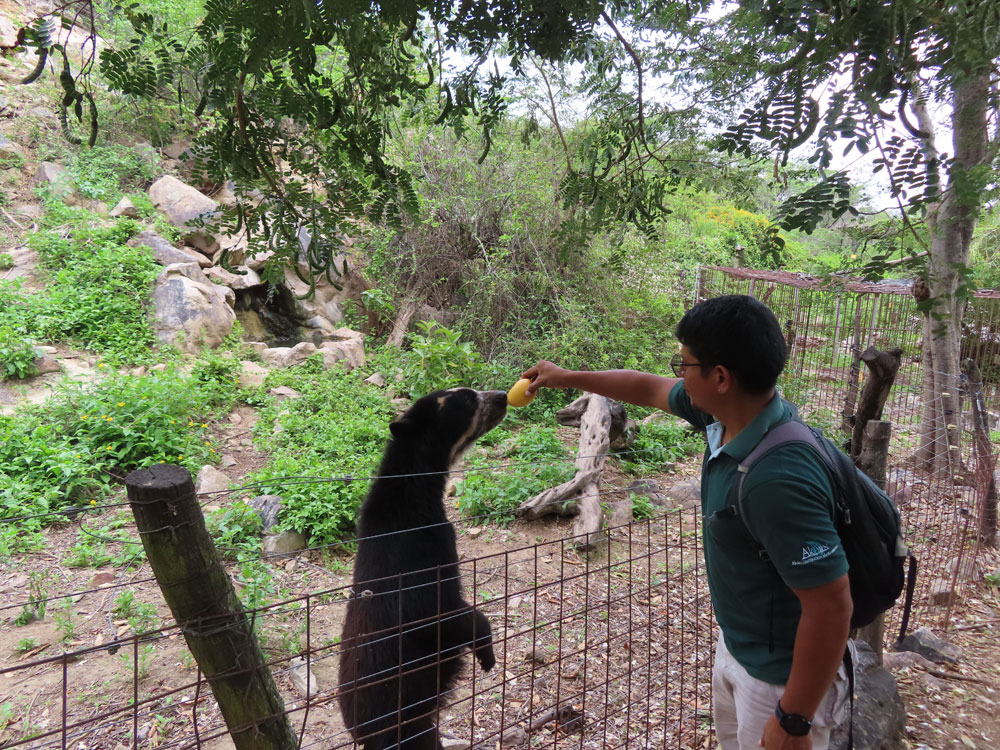
Friday, January 17, Chiclayo to the Bear Sanctuary. We left Chiclayo at 8 am and it was an hour and 3/4 to the outskirts of this sanctuary where we picked up Johanna the local guide. It then turned out to be another whole hour on terrible roads through river beds et cetera to the sanctuary. Chaparri. We went on a 3 hour walk to see the Spectacled bears. Joanna showed us many other things too and the bears themselves were behind a fence with electric wire. Orlando had bought fruit on en route to feed these animals and they stood on their hind legs to receive it, but it was still difficult to take photographs without the electric wire. We also saw a fox in the open and various animals like honey badgers and snakes. 1:30 pm we stopped for lunch which was the same beef rice and chips that we had had the previous day but this time the beef was tender. We spent an hour for lunch in a very pleasant setting and then set off back to pick up our car. The journey back once again difficult that they had sent a new car for us as the one we took going there had no seatbelts and no air-conditioning the last and first hour of this journey were particularly bumpy but it was better with the new car which was a 4x4.
Click on thumbnail photo below to get larger photo
 |
 |
 |
 |
 |
 |
 |
 |
 |
 |
 |
 |
 |
 |
 |
 |
 |
 |
 |
 |
 |
 |
 |
 |
 |
 |
 |
 |
 |
 |
 |
 |
We arrive back in Chiclayo around 5:30 pm and I had a siesta and then washed my hair. We have a snack and a rum and tonic before going down to the bar for yet another Pisco sour. Then back to the room for another snack before turning in for the night.
Saturday, January 18. Chiclayo to Lima We packed up for the return journey had breakfast and met up with Orlando at 9 am We then drove to a handicraft shop where I was hoping to buy a local sweater at a reasonable price but it was closed anyway so we continued on to another archaeological site, Cerro Ventarron, which was obviously only rarely visited it was a large site and a lot of excavations had been carried on there in the past, but none for the last few years as the government had expelled the archaeologist whose chief interest it was, on some dubious grounds.
Ventarrón is the site of a 4,500-year-old temple with painted murals, which was excavated 2007. The site was inhabited by the Early Cupisnique, Cupisnique, Chavin and Moche cultures. The temple and murals were radio carbon dated to 2000 B.C., the latter of which is thought to be the oldest discovered in the Americas. One mural on two walls depicts a deer caught in a net; another has an abstract design in red and white.The temple was constructed of bricks of river sediment rather than the stone or adobe later to be traditional in the area; its construction is unique for the northern coast. It contains a stairway leading to a fire altar.
In 2017, a fire, reportedly caused by farmers burning nearby sugar cane fields, damaged much of the site
Click on thumbnail photo below to get larger photo
 |
 |
 |
 |
 |
 |
 |
 |
 |
 |
 |
 |
Meanwhile, I was starting to feel quite ill, but we went back to the handcraft shop which was now open but there was nothing in it that we wanted at all. We got the guide to take us in the car round the Plaza de Armas in Chiclayo
Click on thumbnail photo below to get larger photo
 |
 |
 |
And then we arrived at the airport by 11.40 for our flight at 2:50.