Only for us possible on last full day 11 July. Departures at 2.30 and 4.00 p.m. (Diesel only – Reduced price). Museum open from 2.00 to 5.45 p.m.
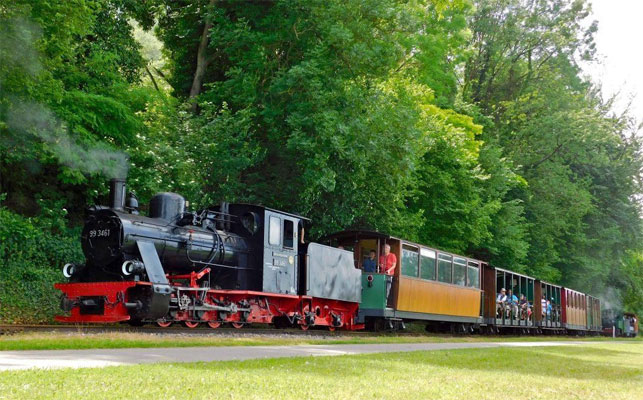
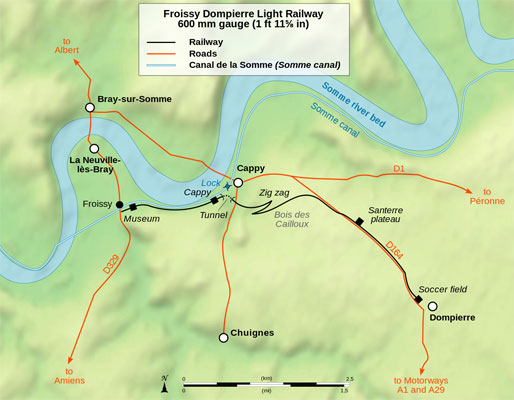
The Froissy Dompierre Light Railway (French: Chemin de fer Froissy-Dompierre, CFCD) is a 600 mm (1 ft 11+5⁄8 in) narrow gauge light railway running from Froissy (a hamlet of La Neuville-lès-Bray) to Dompierre-Becquincourt, through Cappy, in the Somme department, France. It is run as a heritage railway by APPEVA (Association Picarde pour la Préservation et l'Entretien des Véhicules Anciens) and is also known as P'tit Train de la Haute Somme. It is the last survivor of the 600 mm (1 ft 11+5⁄8 in) narrow gauge trench railways of the World War I battlefields.
The « Petit train de la Haute Somme » is the last remaining section of a large military network built during WW1. The site is situated right in the zone of the battle of the Somme (July to November 1916) where British and French armies had built a considerable network to prepare the offensive of July 1st 1916 and supply the artillery, the tommies and the « poilus » French soldiers in trenches.
The Froissy – Cappy line, along the canal, was part of « Line B » which started from the village of Cerisy/Les buttes (near Villers-Bretonneux). This line was serving the whole zone from the ponds area to Frise. In 1916, the line was extended to follow the advance of the soldiers across marshes to the villages of Hem, Cléry and Bouchavesnes. To join the front, steam locomotives were replaced in the village of Frise by petrol engines, more difficult to spot by the enemy; ammunition traffic to the front line was standing generally at night.
The little train was able to carry up to 1500 tonnes of ammunition a day. After WW1, the network was reused from 1919 to 1924 by the « Ministère des Régions Libérées » (French Ministry in charge of the reconstruction) to rebuild this devastated area. Then, the sugar refinery at Dompierre reprocessed the lines laid unused on the plateau. The refinery used them for its sugar beet transportation and its connections with the « Compagnie des chemins de fer du Nord » (standard gauge railway company) in Chaulnes (15km) and the canal of the Somme at Cappy (6km).
In 1970, some railway enthusiasts decided to save the line that the sugar refinery was about to give up. They created the « Association Picarde pour la Préservation et l’Entretien des Véhicules Anciens – APPEVA » (society for preservation and restoration of heritage vehicles). They rebuilt the track from Froissy to Cappy (1,5 km) with rails remaining from WW1 and hunted for steam locomotives all over France. The very first passenger train ran on June 13, 1971 and the first steam locomotive on July 14 of the same year. The society volunteers bought up the line and the railway rolling stock used by the sugar refinery in 1974, and little by little adapted it to passenger traffic. As there were no railway buildings along the line, the society members built a shed, then a little station at Froissy, and in 90’s, a museum where a part of the collection is on show : 35 steam or diesel engines and a bit more than 120 wagons.
The Musée des chemins de fer Militaires et Industriels (Military and Industrial Railways Museum), located near the line terminus in the hamlet of Froissy (French commune of La Neuville-lès-Bray), features a large collection of 600 mm (1 ft 11+5⁄8 in) gauge railway material, steam engines, diesel engines and wagons, in an 1,800 m2 (19,000 sq ft) exhibition hall inaugurated in 1996. It also features an interesting Fairbanks-Morse speeder of 1917, used by the US Army.
The « P’tit train de la Haute Somme » is situated in the hamlet of Froissy (little village, not indicated on maps), 3 km South of Bray-sur-Somme on the D329 road.
Adult : 12,00 Euros. Prices include the return journey, a part with a steam engine, the other part with a diesel engine, and the visit of the Narrow gauge railways museum, the biggest narrow gauge railways museum (1800 m²).