

Mangareva is the central and largest island of the Gambier Islands in French Polynesia. It is surrounded by smaller islands: Taravai in the southwest, Aukena and Akamaru in the southeast, and islands in the north. Mangareva has a permanent population of 1,239 (2012) and the largest village on the island, Rikitea, is the chief town of the Gambier Islands. The island is approximately eight kilometres long and, at 15.4 km2 , it comprises about 56% of the land area of the whole Gambier group. Mangareva has a high central ridge which runs the length of the island. The highest point in the Gambiers is Mount Duff, on Mangareva, rising to 441 metres (1,447 ft) along the island's south coast. The island has a large lagoon 24 kilometres in diameter containing reefs whose fish and shellfish helped ancient islanders survive much more successfully than on nearby islands with no reefs.

Mangareva was once heavily forested and supported a large population that traded with other islands via canoes. However, excessive logging by the islanders between the 10th and 15th centuries resulted in deforestation of the island, with disastrous results for both its environment and its economy . The first European to visit Mangareva was a British captain, James Wilson, who arrived in 1797 on the ship Duff. Wilson named the island group in honour of Admiral James Gambier, who had helped him to equip his vessel. Mangareva and its dependencies in the Gambier Islands were ruled by a line of kings – and, later, regents – until the French formally annexed the islands. King Maputeoa requested a French protectorate on 16 February 1844, but the French government never ratified it. On 4 February 1870, the Mangarevan government and its prince regent, Arone Teikatoara, formally withdrew the protectorate request and asked the French not to intervene in the kingdom's affairs. However, after Father Honoré Laval was removed to Tahiti, the native government changed its stance: On 30 November 1871, Prince Regent Arone and the French colonial authority in Tahiti signed an agreement reaffirming the islands’ protectorate status. The Gambier Islands were finally annexed on 21 February 1881 under Prince Regent Bernardo Putairi, and the annexation was approved by the President of France on 30 January 1882
Apríl 3rd
At sea. Talks by Lea on fish and by Damon on the Polynesian isñands we would be visiting. Took a German lunch up from the restaurant to eat on deck. Dmitri's talk on Captain Cook's second voyage and recap and briefing. We had to abandon plans to eat in Hot Rocks due to rain showers, so had a fast meal in the restaurant before going to the enjoyable crew show, eight contributors, mainly from the Philippines, but one from Kenya
click on a thumbnail to get a bigger photo
 |
 |
 |
 |
 |
 |
 |
 |
April 4th
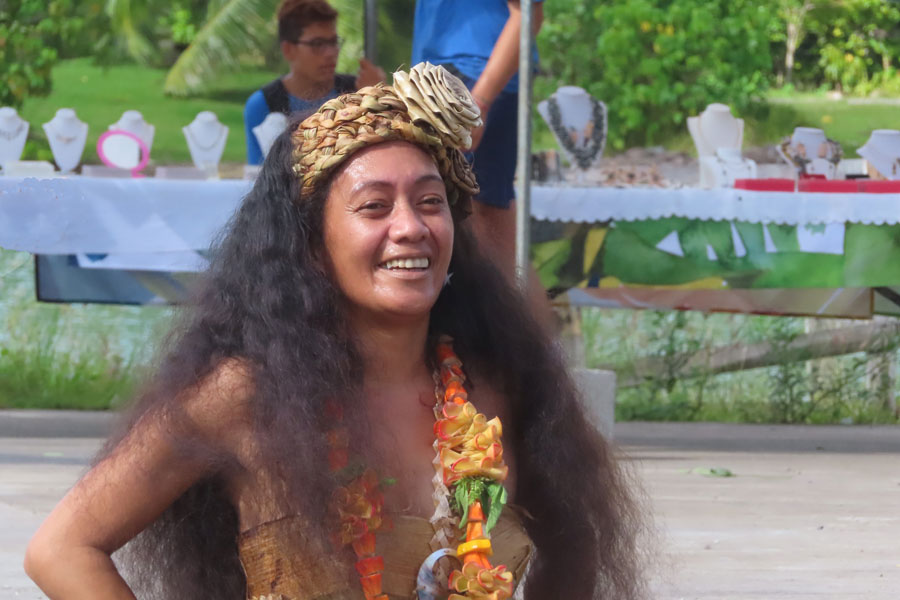
The ship arrived at Mangareva, French Polynesia, by 07.00 and worked its way through the myriad oyster beds in the lagoon. After breakfast we had an efficient Immigration clearance. Then went ashore in a flat calm. There was a, rather too long, Welcome Ceremony of native dancing and music; no where to sit down to enjoy it though!.
Then we set out on a guided walk, with little guidance. After the chapel we strolled out ahead, visiting the huge cathedral and then continuing in search of the ruined convent, Rouri; but we had taken the wrong road and walked for a mile or so parallel to the shore in vain, and 2 lots of natives could not understand us. It was an idyllic walk though.
Returning to the cathedral one of the 5 shuttle jeeps offered us a lift; this was greatly appreciated as it was a long way away and uphill to the convent ruins. Half way there we picked up Margot and JP and I realised how good a deal he had got in the lottery of life- wives!. The eerily beautiful remains of Rouru Convent, which once housed 60 nuns, stands south of the cemetery and is quickly becoming engulfed by weeds. It’s said that the priest hid the entire female population of the island in the convent whenever whaling ships paid a visit.
We walked back, detouring into the cemetery where their last king, Maputeoa, was buried. We caught the last zodiac from the pier to Akena Beach at 11.30 - quite a rough ride of 20 minutes. There was precious little beach and , on landing, we then had to wander some way in up to 2 feet of water along the shore to where the snorkelling and swimming was taking place. We stripped off and went into the crowded water - very unsatisfactory and not what we had anticipated. Soon came out and after negotiating the high tide back to the landing area, endured a really rough 15 minute trip back to ship. Then a tropical shower, so had lunch in the restaurant before spending the afternoon on the back deck. Enjoyed a Pina Colada there and the sunset. Ate up at Hot Rocks
click on a thumbnail to get a bigger photo
 |
 |
 |
 |
 |
 |
 |
 |
 |
 |
 |
 |
 |
 |
 |
 |
 |
 |
 |
 |
 |
 |
 |
 |
 |
 |
 |
 |
 |
 |
 |
 |
 |
 |
 |
 |
 |
 |
 |
 |