

Fatu Hiva
Like the other islands of the archipelago, Fatu Iva was originally populated by Polynesians, who probably came from Western Polynesia. Rivalries between the different valleys were frequent. In one of them, around the middle of the 19th century, the Anainoapa tribe of Hanavave and the Tiu of Omoa confronted each other. The latter, defeated, fled the island on bamboo rafts and ended up in the Tuamotus, on Napuka Atoll, where their descendants still live.
Little is known of Fatu Hiva culture before European influence, as it was greatly affected by the arrival of the missionaries. Stratified tribal societies were formed in the great valleys, as in the rest of the Marquesas Islands. In 1897, the German explorer Karl von den Steinen described nine tribes inhabiting the Hanamoohe, Hanateone, Hanahouuna, Ouia, Hanavave and Omoa valleys. In the Hanavave valley, four tribes are known from the stones. Systematic archaeological excavations have not yet been carried out. Surface investigations were carried out by the American anthropologist Ralph Linton on behalf of the Bishop Museum of Honolulu in 1920–1921. The finds are less numerous than on the other islands of the Marquesas and indicate less extensive building activity. Linton found the remains of several tohua (ceremonial and power centers) with dwelling platforms (paepae) and small me'ae in the Omoa Valley. This led Linton to suspect that several tribes had resided there. During his brief visit to the Hanavave Valley, Linton was only able to find small remains of a tohua and a ceremonial stone platform. Unlike the other islands of the Marquesas, the dead of Fatu Hiva were occasionally mummified (smoked) and often buried in the dwellings. No colossal stone statues have been found on the island, but some small, crude stone sculptures have been preserved. The island was known for tattoo artists and wood carvers, whose ephemeral works have barely survived the ages.
From a Western perspective, the first explorer to discover Fatu Iva was the Spanish navigator Álvaro de Mendaña, on July 21, 1595. It was the first island in the archipelago that he saw, but he was unable to land there because he could not find a safe anchorage. He mistakenly believed that he had found the Solomon Islands, the goal of his voyage, before realizing that he had just discovered a new land. He named the archipelago "Marquesas de Mendoza", in honor of the viceroy of Peru at the time, who had helped him launch his expedition. As Mendaña arrived during the vigil of St. Mary Magdalene in 1595, he named the place Isla Magdalena.
In 1937 and 1938, Norwegian anthropologist and adventurer Thor Heyerdahl and his wife Liv lived for a year and a half in Fatu Iva, first in Omoa and then in Ouia, a now deserted valley on the eastern coast of the island. Officially commissioned by the University of Oslo to investigate the distribution and spread of animal species among the Polynesian islands. The couple landed on Omoa in 1937, but found that civilization was still too much for their liking. They crossed the island and settled in Ouia, on the east coast of the island, a valley formerly inhabited by marqueses. However, after a year and a half, mosquitoes, disease and bad weather dampened their enthusiasm. He recounted his experience in the book Paa Jakt efter Paradiset (1938), rewritten in 1974 and published as Fatu Hiva, the return to nature.
In the early 1960s, until 1966, most of the island's men went to work in Moruroa, in the Tuamotu archipelago, on the construction of the Pacific [Nuclear] Experimental Center. On March 11, 2011, Swiss explorer Raphaël Domjan, expedition leader of the PlanetSolar adventure, the first ship to circumnavigate the planet on solar power, called at Fatu Hiva.
Omoa, Fatu Hiva
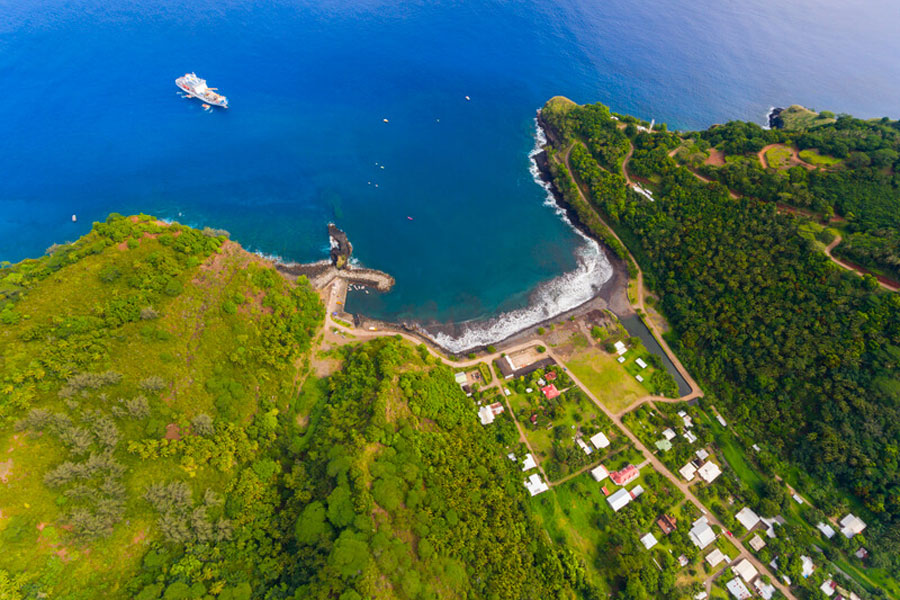
Ridges and cliffs form the beautiful, rocky Fatu Hiva, the southernmost of the Marquesas Islands in French Polynesia. The half-moon-shaped Omoa Bay encircles the village of Omoa, where about 250 people reside near the island’s main church. They make tapa cloth in a traditional way with beaten bark decorated in inked traditional Polynesian designs. The island is covered in lush jungle vegetation that is divided in some places by narrow ravines marked by sharply dropping cliffs. The ruggedly beautiful Bay of the Virgins, appears as if its palm tree-lined, jutting rocky ridges were carved by some great hand into stone sculptures

A sea day before getting to Mangareva
click on a thumbnail to get a bigger photo
 |
 |
 |
 |
 |
 |
 |
 |
 |
 |
 |
 |
April 7th . Omoa, Fatu Hiva
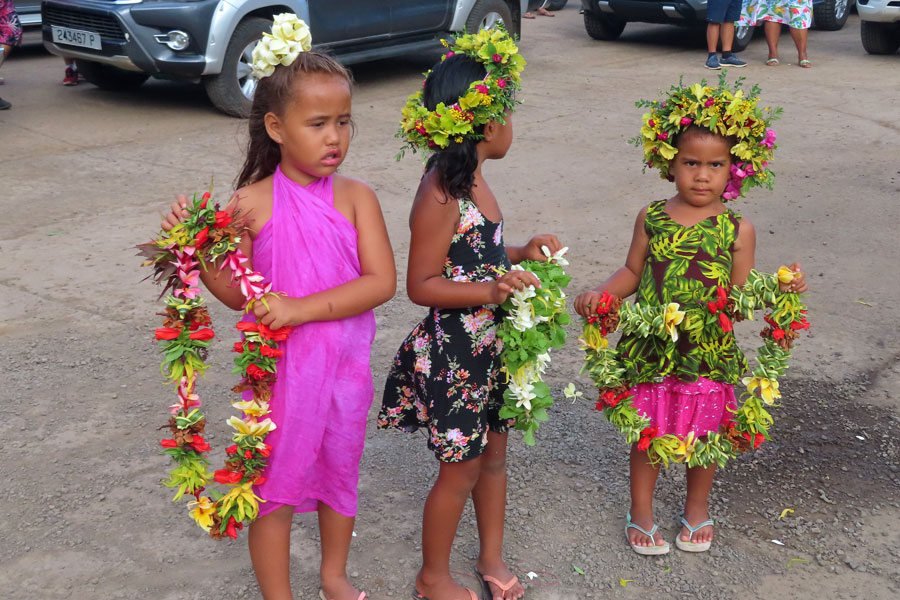
A sleepless night with the television coming on seven times during the night. The ship arrived at Fatu Hiva in the Marquesas by 07.00 am. Went. ashore at Omoa soon after 08.00. A lovely welcome with 3 small children giving us their flower garlands. . We then walked up to the large town meeting place, still beside the sea; there were lots of things for sale. Eventually their art and craft demonstrations began, but it was somewhat disorganised.
click on a thumbnail to get a bigger photo
 |
 |
 |
 |
 |
 |
 |
 |
 |
 |
 |
 |
 |
 |
 |
 |
 |
 |
 |
 |
 |
 |
 |
 |
 |
 |
 |
 |
 |
 |
 |
 |
 |
 |
 |
 |
After this the majority of us walked up to the Petroglyph of a large tuna, passing through pleasant coconut plantations. The petroglyph was plainly visible exactly as Thor Heydahl had described it with as a large fish surrounded by concentric circles. We spent a few minutes exploring the other smaller petroglyphs on the surrounding boulders and pictured a native diligently chiseling away with his rudimentary tools.The origin of the petroglyph has been lost over time, and guides make up "interesting " stories about its origins
click on a thumbnail to get a bigger photo
 |
 |
 |
 |
 |
 |
 |
 |
 |
 |
 |
 |
 |
 |
 |
 |
Once back at the meeting area we had to wait quite a while before being loaded into the 22 jeeps assembled; we shared with Ian and Christine. It needed that many jeeps as there was no other larger transport available, and each jeep only took 4 punters. Then a most impressive drive to Hanavava with several stops for the majestic scenery. The road was dirt for most of the way and quite bumpy, but the scenery made it worth while. Right at the top we sat on the cliff edge and ate the picnic provided by the ship, absolute bliss.
click on a thumbnail to get a bigger photo
 |
 |
 |
 |
 |
 |
 |
 |
 |
 |
 |
 |
 |
 |
 |
 |
Hanavave, Fatu Hiva
Hana Vave is the name of the northernmost bay on the west coast of Fatu Hiva in French Polynesia. The bay is sometimes called the Bay of Virgins, a translation of the French name Baie des Vierges. The French name originally given to the bay was Baie des Verges (Bay of Penes), because of the phallus-shaped basalt spires that rise on either side of its entrance. Hana Vave is also the name of a small village located at the head of the bay, which in 2020 had an estimated population of 346.

Sometimes called the ‘island at the edge of the world’, Fatu Hiva is also the greenest, wildest and most mountainous island of the Marquesas. The island’s dramatic cliffs and lush valleys, illuminates the extraordinary Polyenian countryside, will give you the impression of being in a Paul Gauguin painting. On your arriving in this tropical paradise, we were welcomed with the traditional welcome to the Marquesas Islands, ‘Mave Mai’, involving ancestral dances. The spectacular Baie des Vierges is said to be one of the most beautiful bays on Earth.
Once we got down on the other side to Hanavara, we were, much to my annoyance, driven to a number of "Opportunies to Shop" , for honey, beach wraps, trinkets.
Then a long noisy wait for their welcome dances: 2 young girls, say 6 & 7, who stood in the doorway imitating their mothers were fascinating.
Their long hike turned out to be just back up the road we had driven down, so we wandered by ourselves, crossing the river on stepping stones , with help from a local but then had difficuñyi shaking him, and his red car, off. But eventually we had a pleasant stroll.. stopping at the next ford we encountered!. We passed Robert from receptoin and encountered an aggressive, but tied up, bull.
On our way back to the zodiacs we passed the local church, which was packed and singing was vibrant. We were not sure whether it was a Good Friday service or even possibly a colourful, happy funeral; people were constantly entering and leaving
click on a thumbnail to get a bigger photo
 |
 |
 |
 |
 |
 |
 |
 |
 |
 |
 |
 |
 |
 |
 |
 |