
After leaving Puerto Natales we only had one more shore trip, which was at Punta Arenas, before reaching Ushuaia. But we did get a zodiac ride at the Garibaldi Glacier
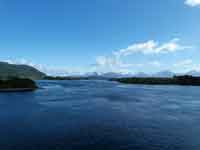
From Puerto Natales we ran the White Narrows in the reverse direction. We had blue skies, which had been missing the day before when we passed on the way in to Puerto Natales. But though the sky was clear, there were really strong cross winds as we nosed through the narrow gap.
Click on any thumbnail photo to get a larger picture
 |
 |
 |
 |
 |
 |
 |
 |
 |
 |
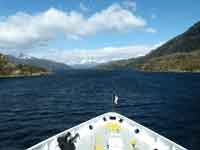
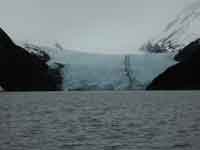
Garibaldi Glacier was the zodiac ride that we had after leaving Punta Arenas. The omens did not look good as we nosed down the fjord that ended with the Garibaldi glacier. Sleet, wind, and a heavy swell made it look as if getting into zodiacs would be too dangerous, let alone too uncomfortable. We passed the Le Boreal, which was on her way out of the fjord, having decided to abandon her efforts to get zodiacs launched. Half an hour later we got to the head of the fjord, and the Explorer dropped anchor.
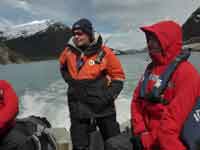
Cunning thing was it was round a corner from the glacier, one could not actually see the glacier. We sat in the warmth of the observation lounge and debated on whether to go out if the zociacs were on. I decided it was worth it to see the glacier, and we retiired to the cabin to don full Arctic gear. By the time we waddled down to deck three, it had been decided that it was on, so we were straight into the first zodiac with Kara, and off to the glacier. Miraculously the weather had changed, the wind and swell dropped, and the rain and sleet stopped. You could hardly call what was left as being a balmy tropical day, but it was quite bearable, bundled up as we were.
We passed cormorants, seals and interesting rock formations on the long ride up to the glacier, as well as the ever-present waterfalls.
Silverseas surprised me by bringing up a crew boat to give us champagne and chocolates - probably hot rum punches would have been too difficult to serve in the swell. By the time we got back to Explorer, the wind and swell had risen, so we were lucky to have had the window in the weather
Click on any thumbnail photo to get a larger picture
 |
 |
 |
 |
 |
 |
 |
 |
 |
 |
 |
 |
 |
 |
 |
 |
 |
 |
 |
 |
 |
 |
 |
 |
 |
 |
 |
 |
On to Ushuaia with blue skies much of the way, passing another shipwreck, the Santa Leonor, en route
On March 31st 1968, the merchant Santo Leonor ran aground in Paso Shoal on the Adelaide rocks in Paso Shoal, Chile. The Santo Leonor was owned by the Grace Line and was used in the Buenos Aires-Valparaiso route. The crew of 51 and 7 passengers were saved by the tug Colo-Colo. At the time of the accident she was travelling from Rio de Janeiro to Vancouver (Canada), under the command of Captain Donald Johnson and governed by the Chilean pilot Ernest Ruiz Muñoz. She hit a reef at SW of Isabel Island, then drifted to Adelaide island where she laid on the starboard side. The shipwreck was attributed to a navigational error.
The Santa Leonor was launched as USS Riverside (APA-102) and was a Bayfield-class attack transport. During World War II, she was tasked to deliver troops to the battle front, and to recover and care for the wounded. She served in the Pacific Ocean in the war against Japan. She was sold to Pacific Argentina Brazil lines (P&T) in December 1948, renamed SS P&T Forester. She was then sold to Moore McCormack Lines Inc. in March, 1957, renamed SS Mormacwave and sold for the final time to Grace Lines Inc. in August, 1966, renamed SS Santa Leonor.
Click on any thumbnail photo to get a larger picture
 |
 |
 |
 |
 |
 |
The voyage on Silversea Explorer in South America