
Hampi is home to the medieval ruins of the once great capital of the Vijayangara Empire. Between 1336 and 1565, this now small town lay at the centre of a Hindu empire that was one of the largest in all India, once believed to rival that of Rome.
It was a fortified city. Chronicles left by Persian and European travellers, particularly the Portuguese, say that Hampi was a prosperous, wealthy and grand city near the Tungabhadra River, with numerous temples, farms and trading markets. Hampi-Vijayanagara is estimated to be the world's second-largest city by 1500, after Beijing, and probably India's richest at that time, attracting traders from Persia and Portugal. The Vijayanagara Empire was defeated by a coalition of Muslim sultanates; its capital was conquered, pillaged and destroyed by Muslim armies in 1565, after which Hampi remained in ruins.
It is a UNESCO World Heritage site, and has been described by UNESCO as an "austere, grandiose site" of more than 1,600 surviving remains of the last great Hindu kingdom in South India that includes "forts, riverside features, royal and sacred complexes, temples, shrines, pillared halls, mandapas, memorial structures, water structures and others".
Evolve Back Hampi
This is where we stayed. Inspired by the magnificent royal palaces, temples of the Vijayanagara rulers at Hampi, Evolve Back Hampi is a luxurious hotel set within lovely landscaped gardens featuring reflecting-pools and flowing fountains. The property’s grand architecture is particularly appealing and with striking Hindu and Islamic architectural features including elegant domes, recessed arches and ornamental vaults.
Accommodation at Evolve Back Hampi is comprised of stylish and luxuriously appointed Water Zenanas (private pool villas) that are scattered around the hotel’s extensive grounds, and elegantly decorated Palace Suites and Palace Studios located within the property’s opulent ochre coloured main building. Facilities include a multi-cuisine restaurant, discreet private dining venues, bar, an infinity-edge pool, and a Spa offering traditional Ayurvedic massages. Evolve Back Hampi is located twenty minutes’ drive from Hampi’s archaeological treasures
Most reviews will tell you this is a great place to stay, and that is how we found it . It is well run , close to the UNESO Hampi site and a lot of other temples. Plus the hotel supplying many daily activities.
You will not get bored here Nature walk, Afternoon Tea, History Lecture, Candle Lighting Ceremony.
One comment I would make was that there is a history lecture each evening on a different subject. We went to 2 of them, and were unable to understand the lecturers, even though they were in English. Talking to other guests, the consensus was that British people could not understand the lecturers, but Indian guests could.. I cannot offer any suggestion for improving this
We did have one minor problem. You get assigned a hostess to be your point of contact with the hotel, which is is great idea, but in our case did not quite come off. We were staying 3 nights and wanted to eat in the Specialty Restaurant where they serve you at table. Our hostess on day one claimed to be unable to confirm a booking for any night. So we had to have a buffet the first night - I try to avoid buffets. Second night she still had not confirmed a booking, even though asked the day before - so I had to go to reception. We had a great meal at that Specialty Restaurant, and went back the 3rd night. Quite bizarrely it was empty, and we were the only customers. Unbeknown to us (hostess had not told us) there was a special poolside buffet and Barbecue, which every other guest went to - I would still have chosen the served restaurant
Click on thumbnail photo below to get larger photo
 |
 |
 |
 |
 |
 |
 |
 |
 |
 |
 |
 |
 |
 |
 |
 |
 |
 |
 |
 |
 |
 |
 |
 |
 |
 |
 |
 |
Sunday, February 23.
We were met by a driver at Hampi Airport and were driven a three hours to the Evolve Back Hotel. The driver seemed to want to talk to us but only about sport which seemed a bit futile as we knew little about this and he was difficult to understand .
We ate the sandwiches in the back of the car that we had received on Indigo en route and had a short siesta, the scenery not being very interesting although there were some rice fields which at least meant that we were likely to be in India!. We arrived at the impressive looking hotel by 16.30 and had a welcome drink and a short talk by their historian and then went to our room where the receptionist insisted on showing us everything leaving us little time to freshen up before a nature walk at 5 pm: a quick turn round but we made it just in time have rescued walking shoes from the suitcases.
The nature walk was round the grounds and into the hotel’s forest which was more a shrub forest and not what in Europe we would take for a forest. He showed us many birds having first equipped the five of us with binoculars . We also saw termite mounds and various trees, like wild basil and wild mint. So a good occasion.
Click on thumbnail photo below to get larger photo
 |
 |
 |
 |
 |
 |
 |
 |
Once back at base I went for a swim in the magnificent pool which in fact was quite difficult for me to get in and out of they obviously cater for a younger client. One of the things we have noticed in India is that we are constantly being asked for our age and after we reply their reply is always "Oh my God." By this time it was dusk and we had another fairly quick turnaround which included a lukewarm shower before going to the evening history story talk. This was in an impressive room, but we were unable to decipher much of what the speaker was saying. We will have to research Hampi ourselves.
After this we went into the buffet restaurant where I managed to mistake green chilies for green beans and suffered as a result! But the rest of the salad was lovely when serving some hot food for ourselves we came across a chef who was very happy to cook something completely not spicy for me and so I enjoyed some pork shoulder and vegetables and plain rice. All this was followed by far too many tiny puddings then back to the room to unpack a bit and enjoy a coffee.
Monday, February 24 .
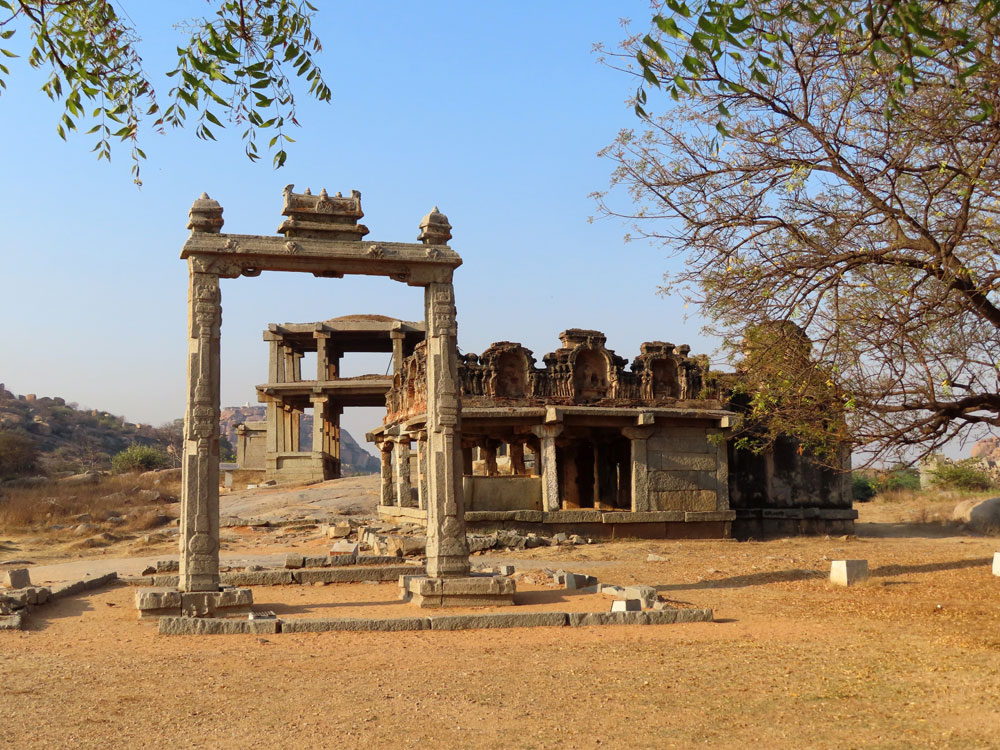
The temples and monuments of Hampi are considered amongst the finest examples of Dravidian architecture anywhere in southern India. We enjoyed a historic tour of some of its highlights, taking in a number of its suburbs (puras) and markets. We visited the renowned Vijaya Vitthala Temple, considered by many to represent the pinnacle of Indian temple architecture. Also the Royal Enclosure and a stroll through the ruins of the Achyutaraya Temple, before walking to the scenic Tungabhadra River.
We were picked up by the driver at 6 am, or rather several minutes after as he was late .We then drove to the village of Hampi where we picked up a new guide, Rasack, his English was much better than that of the driver and we then drove to a place where we saw the sunrise: this involved quite a clamber up it so-called 30 stairs but it was quite a challenge for me. At the top there were a few other people also there to see the sunrise. And also a colourful figure dressed as a Shiva.
We then proceeded to the complex at the northern end of the ruins of Hampi.. this involved a long walk along an unmade road to a place where there were numerous temples, a marriage hall, an iconic chariot which appears on a Rupee 50 note. To try to preserve this complex you are no longer allowed to enter. The building had slim stone pillars that were played for music, and now you could download the sound onto your mobile phone.
We got a golf cart back along the road and met up with our car and driver. Then we stopped at the Queens bathing pool which was quite interesting.
Click on thumbnail photo below to get larger photo
 |
 |
 |
 |
 |
 |
 |
 |
 |
 |
 |
 |
 |
 |
 |
 |
 |
 |
 |
 |
 |
 |
 |
 |
 |
 |
 |
 |
We got back to the hotel before 10 and had a pleasant breakfast at really nice table, although the view over the pool was spoilt by the unseemingly cement wall which formed the boundary of the complex. We then went through an annoying period where our personal assistant had not answered David's request for a meeting to be shown around and she was not on duty until 1130. So another young lady showed us around and also booked us in for a served dinner restaurant for Tuesday, leaving us still to resolve the problem of whether our assistant had booked us in for the current night Monday. We then actually talked to our assistant and she was still waiting on the reservation for that evening or, in our opinion had not actually made the request. We had further problems with her sending a WhatsApp that seemed to suggest that we were no longer going to be picked up at 4 pm but at 3 pm : this eventually turned out just to revolve around her use of the word “revise”.
I had a Jacuzzi which was part of our suite and then went for a swim: here we found there were no towels and all the chair beds were wet and grimy. So after the swim we went to reception and told the manager that he had a big problem there with his staff . We both sat out in the garden for some time and had a coffee and snack there before setting off at 4 pm for a further tour of Hampi temples and buildings. This time we went to an area in the north west of this large complex of a civilisation of up to 1,000,000 who had lived there between 1350 and 1560. We saw various temples some of which still required one’s shoes to be removed so I stayed outside the first one, but was overruled as a much larger one where we spent well over half an hour , so I can understand why I was overruled. Anyway, the shoes came off and I persevered with bare feet on hot and seemingly very dirty paving stones but in fact at the end of the day my feet were not nearly as dirty as they felt. And the temples themselves were well worth it.
Click on thumbnail photo below to get larger photo
 |
 |
 |
 |
 |
 |
 |
 |
 |
 |
 |
 |
 |
 |
 |
 |
 |
 |
 |
 |
We then proceeded to another area. where the guide told us that 13 elephant stables had existed: but this was dubious and nobody actually knew the purpose of these buildings. Then on to a large area where the foundations of palaces had been excavated but none of the walls had survived. There was a large aqueduct here which served several reservoirs one of which had only been excavated in the 1980s .
By this time the Sun was almost setting and we journeyed back to the hotel. We went to the 7:30 pm talk on local stories, but once again we found it impossible to follow the accented English of the person who was given the talk but we did enjoy a cocktail there again. Then on to dinner in the restaurant in the adjacent building, this proved to be a great success and we had a great four course meal. without me having to eat anything spicy another enjoyable and educational day.
Tuesday, the 25th of February.
Aihole, Pattadakal , Badami, considered to be the cradle of Indian temple architecture. Spanning nearly two thousand years of history, these ancient sites encompass an array of Buddhist, Hindu and Jain monuments that date back as far as the 4th-century BC. Aihole alone is home to more than 120 temples, whilst Badami and Pattadakal are both major centres of historically important Chalukya monuments. Located off the beaten track and within some beautiful scenery, these three temple towns are of great historical significance and boast some of the finest art and architecture in India.
We left at 6:15 am with a new driver who is going to be with us for the rest of our stay in India, Anthony Fernandez. We picked up a packed breakfast en route at reception . Anthony spoke English clearly, which was a real bonus. It was a three hour drive, with many many traffic calming humps along the way.
Our first stop which was at Aihole: This was a site with several temples from the 6th to the 8th century. Our guide here was a local middle-aged man who knew the English for what he was saying, but far too quickly and with far too much detail for us to understand, and further did not seem capable of replying to our questions. The wonderful 5th century temples at Aihole is situated in a quaint village. The main attraction here is the unusual horse shoe-shaped Durga temple which is perhaps one of the finest temples in the region. But we did eventually realise that this site had been an architecture school where architects learn the craft, so we could see how some of their work progressed from a drawing to a detailed carving., As all these temples were non-working temples, we were able to go in them with our shoes on.
Click on thumbnail photo below to get larger photo
 |
 |
 |
 |
 |
 |
 |
 |
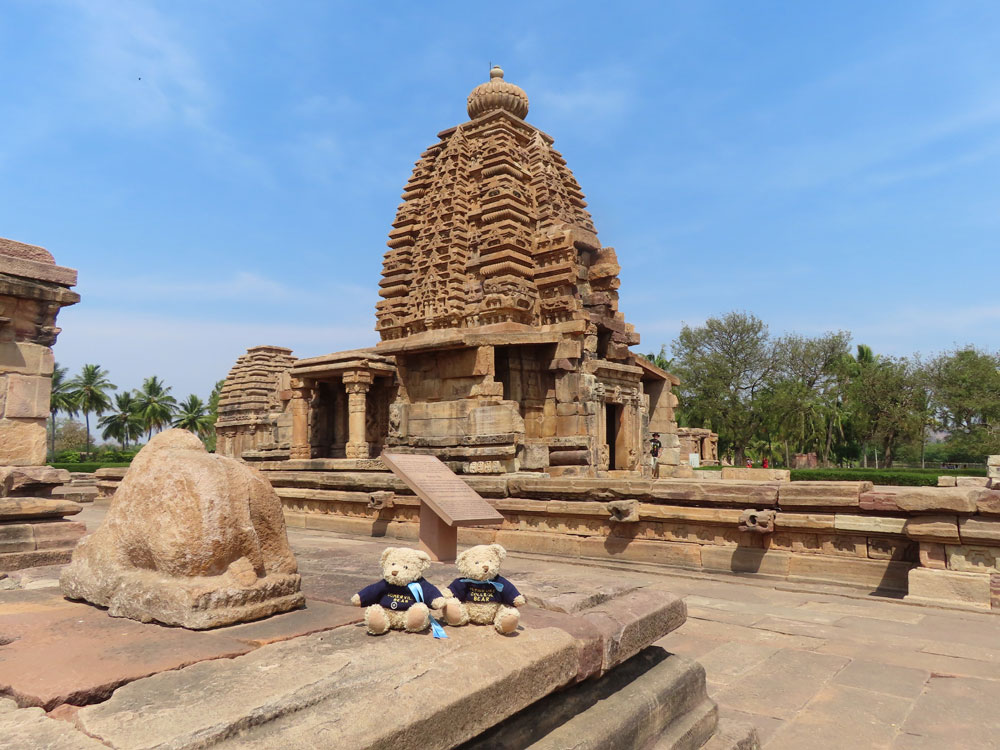
We then got into the car and drove a wee way to Pattadakal, A world heritage site. I actually thought that the first site was more impressive but this apparently could not be recognised by UNESCO as there were too many houses encroached around its edges. In this second site there was one working temple that I decided not to go into it as too difficult to remove and put back on my shoes The UNESCO World Heritage Site of Pattadakal is perhaps one of India’s most impressive Hindu complexes and home to nine temple shrines.
Click on thumbnail photo below to get larger photo
 |
 |
 |
 |
 |
 |
 |
 |
 |
 |
 |
 |
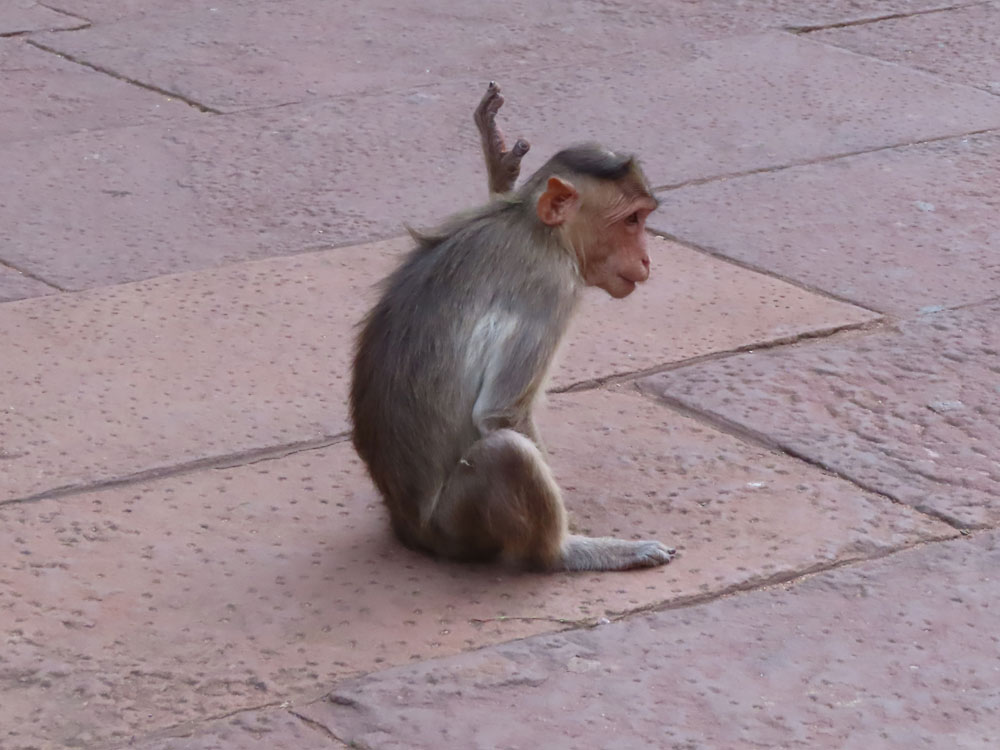
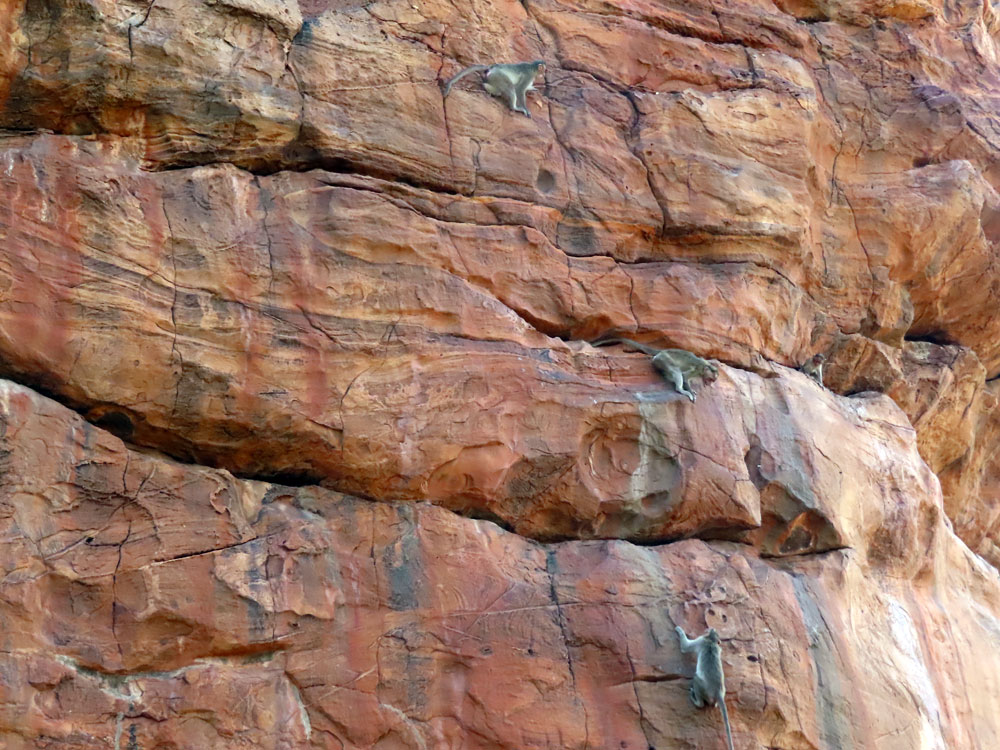
Then another drive of about 30 minutes to Badami. A group of four caves in which temples had been constructed, one Shiva, two Vishnu and the fourth Jain. We climbed up to each of these and the rocks in which the caves existed quite stupendous. I began to comprehend a little more about Vishnu and Shiva through the guides descriptions of the statues there . Badami was once the capital of the Badami Chalukyas, and is set in an idyllic location in a ravine at the foot of a rugged red sandstone outcrop that surrounds Agastya Lake. Having ascended 130 stairs to the top cave which incidentally overlooked a very pleasing water reservoir the local guide then left us and we started the drive back to.Hampi.
Click on thumbnail photo below to get larger photo
 |
 |
 |
 |
 |
 |
 |
 |
 |
 |
 |
 |
 |
 |
 |
 |
When I got back to the room I did a bit of research with the magic glasses. So we got back there well before 5 pm and were able to visit high tea for this first time, but this was nothing special actually. I then had a swim and washed my hair and we went down to reception at 6:15 pm to see the lighting of the candle ceremony which was followed by two guardsman, a piper and four of the hotel staff in a procession around the hotel. At 7:30 we went to dinner and the civilised restaurant and found that we were the only customers for over an hour: this was obviously because there was an outside buffet around the pool which the staff have been setting up for several hours beforehand. We enjoyed our meal, mine with zero spice in a superb table in the window overlooking the hotel, but the service was not quite as good as the previous night.