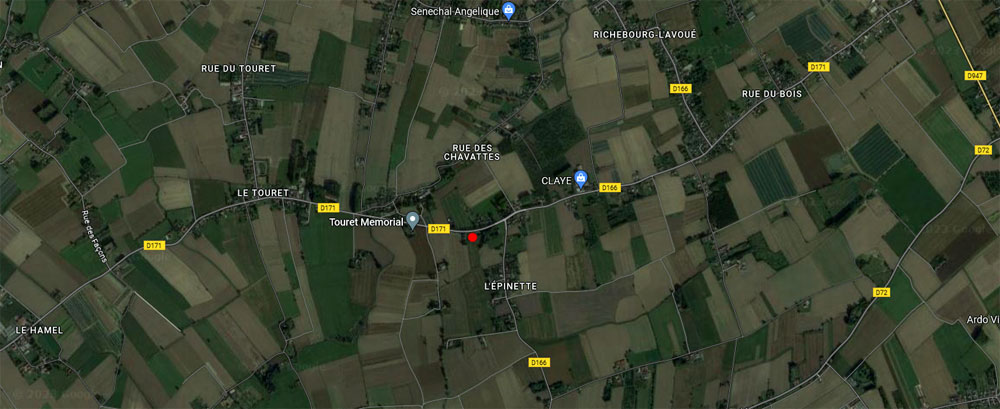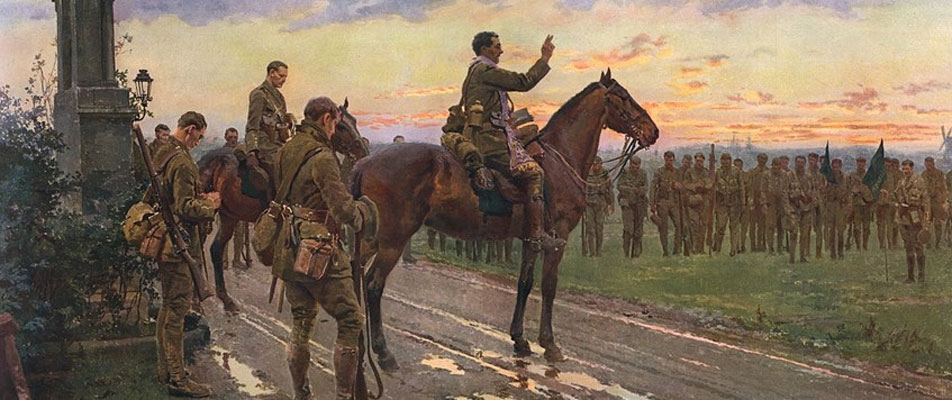
The Last General Absolution of the Munsters at Rue du Bois shows some of the hundreds of soldiers from the second battalion of the Royal Munster Fusiliers who gathered at a shrine near the village of Rue du Bois on the western front on Saturday, May 8th, 1915.
A painting long presumed lost – depicts soldiers of the Royal Munster Fusiliers regiment receiving “general absolution” from their chaplain on the eve of battle in May 1915. Most of them died within 24 hours. The painting, by Italian-born war artist Fortunino Matania, became one of the most famous images of the war when prints of it were published in illustrated weekly newspapers. Copies hung in houses & pubs throughout Ireland, and especially Munster, but, as Irish public opinion towards the war changed, the picture gradually disappeared from view.A copy still hangs in the famous pub Larkins of Garrykennedy Co Tipperary to this day.
Centenary commemorations of the first World War have prompted renewed interest in the whereabouts of the original painting among art and military historians. A widely held theory that the painting was lost when archives were destroyed in a fire during the blitz of London in 1940 is “very much” doubted by English historian Lucinda Gosling, who is writing a book about the artist. She told The Irish Times there was no definitive proof to confirm this theory and it was possible the original painting was still “out there”.
The painting could, conceivably, be in private hands or, more improbably, be lying forgotten or miscatalogued in a museum’s storage area. Matania’s work occasionally turns up at art auctions, but there has been no known or publicly-documented sighting of the original Munsters painting. Ms Gosling described Matania as an artist “able to work at great speed, producing pictures that were unnervingly photographic in their realism”. His pictures, she said, had “reached and influenced millions” and “he combined skill and artistry with a strong streak of journalistic tenacity”.In the painting, the Irish chaplain Fr Francis Gleeson is shown blessing the men: “Misereatur vestri omnipotens Deus; et dimissis omnibus peccatis vestris, perducat vos Iesus Christus ad vitam aeternam” (May Almighty God have mercy on you, and having forgiven all your sins, may Jesus Christ bring you to life everlasting). The men then sang the hymns Te Deum and Hail Glorious St Patrick. The artist was not present at the scene but based his painting on a written account by Lieut- Col Rickard’s widow, Jessie, who is believed to have commissioned the painting in memory of her husband.
The following morning, Sunday May 9th, most of the Irish soldiers were mown down by German gunfire and shelling. On a catastrophic day for the British army – over 11,000 casualties – the Royal Munster Fusiliers suffered dreadful losses. Exact estimates vary, but one account records 800 Munsters went into battle and only 200 assembled that evening. Mrs Rickard concluded : “So the Munsters came back after their day’s work; they formed up again in the Rue du Bois, numbering 200 men and three officers. It seems almost superfluous to make any further comment.”
Father Gleeson is epicted on horseback, with hand raised granting general absolution, is Fr Francis Gleeson, a native of Templemore, Co Tipperary. He was ordained a priest in Maynooth in 1910 and volunteered to serve as a chaplain in the army at the outbreak of the war. He was assigned to the Royal Munster Fusiliers and served with distinction. He survived the war and returned to Ireland where he worked as priest in Dublin and died in 1959.
Although the original still remains lost, It has emerged that Alfred Robinson, whose son Esmond fought in the Battle of Aubers Ridge, commissioned Matania to make a copy of the painting in 1919 to celebrate his son's safe return from the war. Esmond, a two-time winner of the military cross during the war later gave the painting to his nephew Charles. Charles' widow sold the painting for £21,000 (€24,500) at the auction in December 2023.