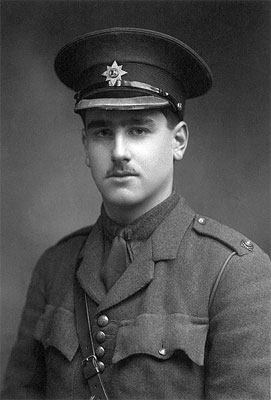
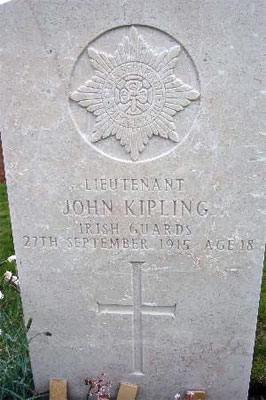
John Kiplink, the son of Rudyard Kipling, was rejected by both Navy and Army because of his short sight. Rudyard Kipling was friends with Frederick Roberts, 1st Earl Roberts, a former Commander-in-Chief of the British Army, and Colonel of the Irish Guards, and through this influence, John Kipling was commissioned as a second lieutenant into the 2nd Battalion, Irish Guards on 15 August 1914, two days before his seventeenth birthday.
After reports of the Rape of Belgium and the sinking of the RMS Lusitania in 1915, Rudyard Kipling came to see the war as a crusade for civilisation against barbarism, and was even more keen that his son should see active service. After completing his training John Kipling was sent to France in August along with the rest of the battalion, which was part of the 2nd Guards Brigade of the Guards Division. His father was already there on a visit, serving as a war correspondent.
Kipling was reported injured and missing in action in September 1915 during the Battle of Loos. There remains no definite evidence relating to the cause of his death, but credible reporting indicates he was last seen attacking a German position, possibly with a head injury. With fighting continuing, his body was not identified. His parents searched vainly for him in field hospitals and interviewed comrades to try to identify what had happened. A notice was published in The Times on 7 October 1915 confirming the known facts that he was "wounded and missing".The death of John inspired Rudyard Kipling to become involved with the Commonwealth War Graves Commission and write a wartime history of the Irish Guards. He also wrote as an epitaph “If any question why we died, / Tell them, because our fathers lied.” However, contrary to popular belief, the poem My Boy Jack does not allude to the wartime loss of his son, rather it was probably written about the death of Jack Cornwell, the youngest sailor killed at the Battle of Jutland. He also wrote the short verse "A Son": "My son was killed while laughing at some jest. I would I knew/What it was, and it might serve me in a time when jests are few."
In 1919 a body was brought in from the old Loos battlefield. Unrecognisable and with no identification disc, all that could be told about him was that he had been a lieutenant in the Irish Guards. The body was buried in St Mary’s Advanced Dressing Station Cemetery under a headstone which read, ‘A Lieutenant of the Irish Guards. Known unto God.’ And John Kipling's grave was never found. However in 1992, Norm Christie, then Records Officer of the Commonwealth War Graves Commission identifeid the grave from interpreting fragments of uniform found on a previously unidentified grave, and Kipling was officially listed as buried in St Mary's ADS Cemetery in Haisnes.In 2002, research by military historians Tonie and Valmai Holt suggested that this grave was not that of Kipling but of another officer, Arthur Jacob of the London Irish Rifles. In January 2016, however, further research by Graham Parker and Joanna Legg demonstrated that the grave attribution to John Kipling is correct. A spokesman for the Commonwealth War Graves Commission stated that it "welcomed the latest research which supports the identification of the grave of John Kipling".
Apart from the 3 2nd Lt, no other Irish Guards lieutenant was missing in the Loos battle sector on that date or at any time during the month while the Irish Guards were in the sector. The Irish Guards did not return to the Loos sector after 1915. Of the three Irish Guards officers who died on 27 September - Kipling, Clifford and Pakenham Law - the burial places of Clifford and Pakenham Law were known during the war. They were both Second Lieutenants. John Kipling was the only man of the three who was entitled to wear the rank of lieutenant on that date. 2/Lt Clifford was known to have been buried behind the German lines; the German Army had returned his identity disc. 2/Lt Pakenham Law was recorded in the Battalion War Diary as having been wounded while digging in on the south edge of Chalk Pit Wood, and that he died of a head wound “in hospital”. The implication of this statement in the battalion War Diary is that that he was removed from the forward battle area at Chalk Pit Wood to be taken to a medical aid post. Law was officially recorded as being buried between Chalk Pit Wood and Lone Tree (Lone Tree was the location of a forward aid post on the day of the battle)