
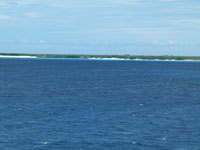
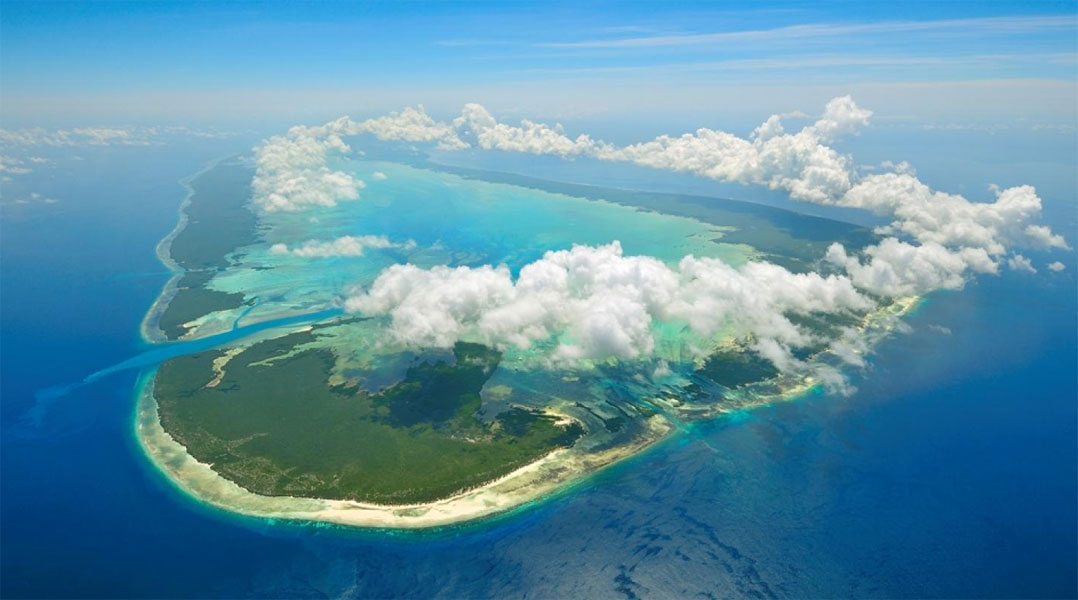
Aldabra is the world's second-largest coral atoll. It is situated a distance of 700 miles southwest of the Seychelles capital, Victoria, on Mahé Island. It is 21 miles long and 8 miles wide. Apart from a small number of rotating scientists, nobody lives on the atoll. We started at Assumpton, in order to clear papers to enter the Seychelles.
Assumption
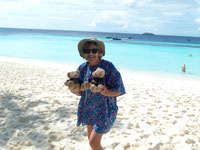
Assumption Island is a small island close to Aldabra, with a distance of 705 miles south-west of Mahé Island. In 2018, Seychelles and India signed an agreement to build and operate a joint military facility on a portion of the island.. The plan stirred up public protests by activists who believed that the islands should stay out of the brewing India-China regional conflict. The agreement was declared "dead" by the Island’s opposition party and the treaty was defeated in the Seychelles parliament in Jun 2018. It does not look as if India will go away, and is likely to keep trying for a base in one form or another
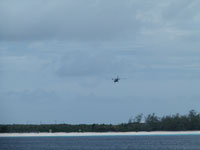
Aldabra does not have an airstrip, so all servicing of Aldabra is done by plane to Assumption, and from there by boat to Aldabra. We needed to pick up, from Assumption, a couple of functionarios to clear the Discoverer into the Seychelles, and a couple of armed guards - Seychelles law requires cruise ships to have the two armed guards in case of pirate attack. The ship's captain keeps their guns unless the guns are required against pirates. I understand that this operation cost about $25,000 for Silversea
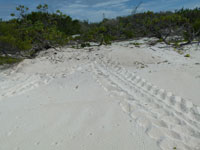
Assumption beach showed signs of recent turtles coming in to nest, plus the signs of baby hatchlings scampering down to the sea.
Click on any of the thumbnails to get a bigger version of the picture
 |
 |
 |
 |
 |
 |
 |
 |
 |
 |
 |
 |
 |
 |
 |
 |
 |
 |
Aldabra
It was visited by Portuguese navigators in 1511. The islands were already known to the Persians and Arabs, from whom they got their name. In the middle of the 18th century, the atoll became a dependency of the French colony of Réunion, from where expeditions were made for the capture of the Aldabra giant tortoises. As there are no surface freshwater sources on Aldabra, the interests of the explorers (no proof of any explorer's visit prior to 1742) was only to exploit the species of tortoise, turtle and fish, and not to inhabit the atoll. In 1810, with Mauritius, Réunion, the Seychelles and other islands, Aldabra passed into the possession of Great Britain. Réunion was later returned to France, and Mauritius gained possession of Aldabra as well as the rest of the Seychelles. The previous inhabitants were emigrants from the Seychelles.
Admiral W. J. L. Wharton of the British Navy landed in Aldabra in 1878 to conduct hydrographic surveys of the islands. In 1888, first settlement was established after the Concession was granted by the Seychelles authorities. The small settlement was established on Picard Island facing west near the beach. The intention was to exploit and export the natural resources of the islands. The villagers built a chapel, in the middle of the badamier trees, with timber and steel which was an essential addition to the plantation houses and office buildings. As Aldabra had no water resources, large rectangular-shaped water storage structures were built adjoining each of the houses. A two-roomed jail was also built in the village, a remnant of which is still seen at Aldabra.
The exploitation of tortoises for commercial purposes at that time is borne out by the remnants of a crushing mill at Picard Island, which was used to crush bones of tortoises, which were also brought in from other islands in the atoll. Efforts made to grow plantation crops of coconuts, cotton, and sisal failed due to inadequate water sources on the atoll; relics of these plantations are still found on some of the islands. In the late 19th century goats were introduced as a food source for the villagers (about 200) living there. Ship rats were introduced and recorded before 1870, and house geckos were noted from the 1970s. Sailors landed on the atoll in the 19th century and attempted to raid the island for tortoises as food; in 1842, two ships were reported to have taken 1200 of them.
By 1900, the tortoises were nearly extinct, and a crew would often have to hunt for three days to find one. In the early 1800s, concessions given to individuals almost destroyed the forests and tortoise habitats in many islands in the Seychelles; on Aldabra Atoll, in view of its remoteness and rugged topography, only small areas of forests were cleared for agricultural operations (mostly coconut plantations) but the tortoises were intensely captured for meat and trade. However, James Spurs, who had the concession of the atoll, was responsible initially for saving the tortoises on the atoll when he banned killing them in 1891.
Following World War II, exploitation of Aldabra for commercial use came to an end and restrictions were imposed on the number of people who could stay on the islands; this number was fixed at 200 at a time. Introduction of invasive species was banned, faunal species were protected under law, and active research on the ecology and biodiversity of the atoll was undertaken by the Royal Society of London from the middle of the 1970s. Aldabra, along with Desroches and Farquhar, was part of the British Indian Ocean Territory from 1965 until Seychelles' independence in 1976.
In the 1960s, as a part of their 'Ocean Island Policy', and to support East of Suez commitments, the British government considered establishing a RAF base on the island and invited the United States to help fund the project in return for shared use of the facility and a settlement of 11 million dollars. Simultaneously (mid-1960s), the British Broadcasting Corporation became interested in Aldabra as a possible site to locate transmitters with which to rebroadcast the BBC Overseas Service (BBC) into the African mainland. The BBC were dependent upon the RAF for developing the atoll as without this their own ambitions would not have been feasible. After an international protest by scientists, however, the military plans were abandoned and the atoll instead received full protection.
Subsequent to the thwarting of plans to establish a military station at Aldabra (which instead focused on Diego Garcia in the Chagos Islands), the Royal Society of London resumed their scientific study of the flora and fauna of the atoll. The Royal Society bought the lease of the atoll in 1970 and their research station became functional from 1970. After completion of their assigned work, the Royal Society left and the Seychelles Island Foundation (SIF), a public trust of Seychelles, took over the management and protection of the atoll in 1979. SIF functions under the patronage of the President of Seychelles and Aldabra was declared a Special Nature Reserve in 1981, and a year later it became a UNESCO World Heritage Site on 19 November 1982. A brass plaque inscribed with the citation "Aldabra, wonder of nature given to humanity by the people of the Republic of Seychelles" is stationed on the atoll.
Click on any of the thumbnails to get a bigger version of the picture
Our first visit was only to the island that has the SIF base, with a BBQ and a walk along the beach
 |
 |
 |
 |
 |
 |
 |
 |
 |
 |
 |
 |
 |
 |
 |
 |
 |
 |
Aldabra Tortoise

The atoll has the largest population of giant tortoises (Aldabrachelys gigantea) in the world (100,000 animals). Tortoise size varies substantially across the atoll, but adult tortoises typically have a carapace length of about 105 centimetres (41 in) and can weigh up to 350 kilograms (770 lb). They are herbivores and feed on a variety of plants, trees and even algae that grows in the freshwater pools.
The tortoises mate between February and May, the females then lay their eggs from June to September in areas with suitable soil layers. They lay eggs (the size of golf balls) in a clutch of three to five eggs every few years in high-density areas and 14-16 eggs in low-density areas. The females can lay several clutches in a year and the incubation period is 73–160 days. The small vulnerable juveniles have to survive the predation by coconut crabs, land crabs, rats and birds. In the past giant tortoises have been relocated to many other islands in Seychelles and also to Victoria Botanical Gardens in Mahé. One of the longest-lived Aldabra giant tortoises was Adwaita, a male who died at the age of about 250 years at Kolkata's Alipore Zoological Gardens in , 2006.
Click on any of the thumbnails to get a bigger version of the picture
 |
 |
 |
 |
 |
 |
A walk on Aldabra
Not much remains of the village which housed 200 workers, and which was there in 1971, when we were here before. The church, jail, and houses of these people are slowly decaying in the tropical climate, and will soon be gone altogether
A violent rainstorm erupted as we started our walk, and photography was therefore limited, but in truth, there was little to see except ruins being consumed by the undergrowth.
Click on any of the thumbnails to get a bigger version of the picture
 |
 |
 |
 |
 |
 |
 |
 |
 |
 |
 |
 |
Exterminating the Madagascar Fody
I cannot say that I altogether understand it, but a considerable amount of money, time, and effort was spent by scientists in eradicating the Madagascar Fody. One of our lecturers on the Discoverer had spent two seasons personally being part of the culling. I can see you would want to remove goats and rats, but a species of fody virtually indistinguishable from the native Aldabra Fody (which I assume is a Darwinian evolution of the Madagascar Fody)- why on earth?
The Madagascar fodies were well- established and took three seasons of dedicated work to remove. The eradication work was particularly tricky because Madagascar and Aldabra fodies are very difficult to distinguish outside the breeding season; even during the breeding season it can be a challenge to identify non-breeding individuals correctly from afar. Most of the eradication was therefore done seasonally, from November to April each year, using mist-nets, so the team could confidently distinguish the invasive fodies from the endemic Aldabra species. Luckily, the invasive fodies were confined to one part of one island

Click on any of the thumbnails to get a bigger version of the picture
 |
 |
 |
Zodiac ride through the Aldabra Lagoon
The highlight of our visit to Aldabra was a Zodiac ride through the lagoon - in one entrance, and out the other. We had been warned that sea conditions were rough, and that only the fittest and most daring of us should participate. Most people in fact took part, and once inside the lagoon it was a flat calm.
Apart from the expected array of birds, there were masses of turtles in the water, plus rays and the odd shark.
We went ashore at La Digi on the way out for a swim
Click on any of the thumbnails to get a bigger version of the picture
 |
 |
 |
 |
 |
 |
 |
 |
 |
 |
 |
 |
 |
 |
 |
 |
 |
 |
 |
 |
 |
 |
 |
 |
 |
 |
 |
 |
 |
 |
 |
 |
 |
 |
 |
 |
 |
 |
 |
 |
 |
 |