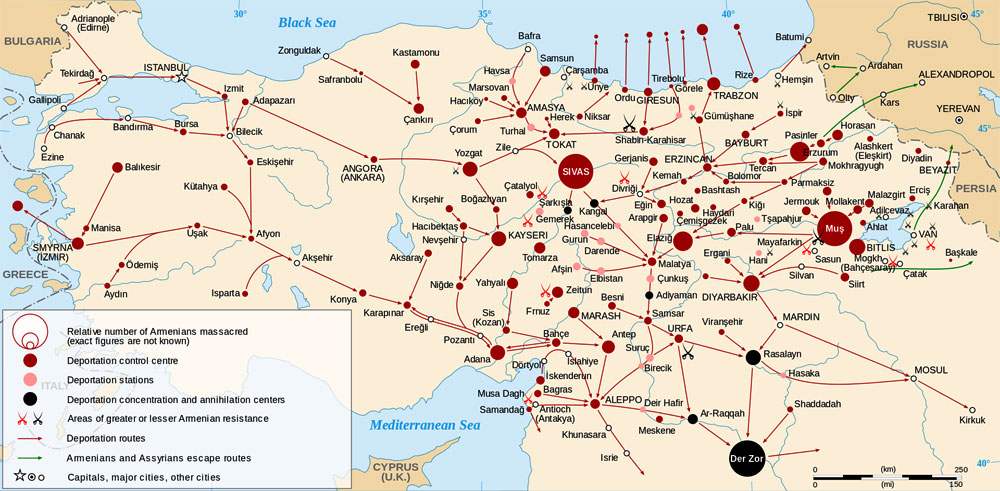
Turkey recognized the modern Republic of Armenia shortly after the latter gained independence in 1991, but the two countries failed to establish formal diplomatic relations. And shortly after this the border was closed. Officially, Turkey closed the border in response to Armenia's war and occupation of territory belonging to neighboring Azerbaijan, a close Turkish ally and supplier of natural gas and energy. Despite efforts by international mediators in 2009 that resulted in a framework agreement signed by Yerevan and Ankara, the militarized border has remained firmly closed since 1993.
The Turkish Government systematically murdered around 1.5 million of the 2 million Armenians living in the Turkish empire
The starting date was 24 April 1915, when the Ottoman authorities rounded up, arrested, and deported about 250 Armenian intellectuals and community leaders from Constantinople and Ankara, the majority of whom were eventually murdered. The genocide the followed was carried out in two phases: the wholesale killing of the able-bodied male population through execution and forced labour: and this was followed by the deportation of women, children, and the elderly on death marches leading to the Syrian desert. Turkey, the successor state of the Ottoman Empire, denies the word genocide as an accurate term for the mass killings of Armenians that began under Ottoman rule in 1915. It has in recent years been faced with repeated calls to recognize them as genocide. To date, 29 countries have officially recognized the mass killings as genocide, as have most genocide scholars and historian. However it is still illegal today in Turkey to talk about what happened to Armenians during this era.
Most sources agree that there were about 2 million Armenians in the Ottoman Empire at the time of the massacre. By the early 1920s, when the massacres and deportations finally ended, some 1.5 million of Turkey’s Armenians were dead, with many more forcibly removed from the country.The Armenian people have made their home in the Caucasus region of Eurasia for some 3,000 years. For some of that time, the kingdom of Armenia was an independent entity–at the beginning of the 4th century AD, for instance, it became the first nation in the world to make Christianity its official religion–but for the most part, control of the region shifted from one empire to another. During the 15th century, Armenia was absorbed into the Ottoman Empire
The muslim Turks had suspicions that the Christian Armenians would be more loyal to Christian governments (that of the Russians, for example, who shared an unstable border with Turkey) than they were to the Ottoman caliphate. At the end of the 19th century, the Turkish Sultan Abdul Hamid II– infuriated by the nascent Armenian campaign to win civil rights–declared that he would solve the “Armenian question” once and for all. “I will soon settle those Armenians,” he told a reporter in 1890. “I will give them a box on the ear which will make them…relinquish their revolutionary ambitions.” Between 1894 and 1896, this “box on the ear” took the form of a state-sanctioned pogrom. In response to large scale protests by Armenians, Turkish military officials, soldiers and ordinary men sacked Armenian villages and cities and massacred their citizens. Hundreds of thousands of Armenians were murdered.
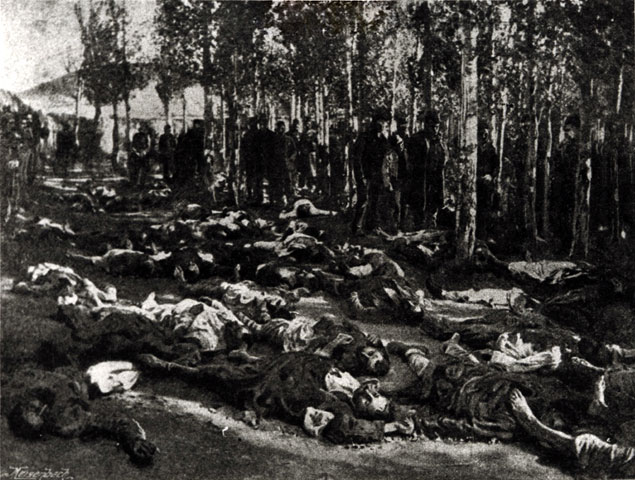
Armenian bodies in Erzerum in 1895
The Rise of the Young Turks In 1908, a new government came to power in Turkey. A group of reformers who called themselves the “Young Turks” overthrew Sultan Abdul Hamid and established a more modern constitutional government. At first, the Armenians were hopeful that they would have an equal place in this new state, but they soon learned that what the nationalistic Young Turks wanted most of all was to “Turkify” the empire. According to this way of thinking, non-Turks–and especially Christian non-Turks–were a grave threat to the new state World War I In 1914, the Turks entered World War I on the side of Germany and the Austro-Hungarian Empire. Military leaders began to argue that the Armenians were traitors: If they thought they could win independence if the Allies were victorious, this argument went, the Armenians would be eager to fight for the enemy. As the war intensified, Armenians organized volunteer battalions to help the Russian army fight against the Turks in the Caucasus region. These events, and general Turkish suspicion of the Armenian people, led the Turkish government to push for the “removal” of the Armenians from the war zones along the Eastern Front.
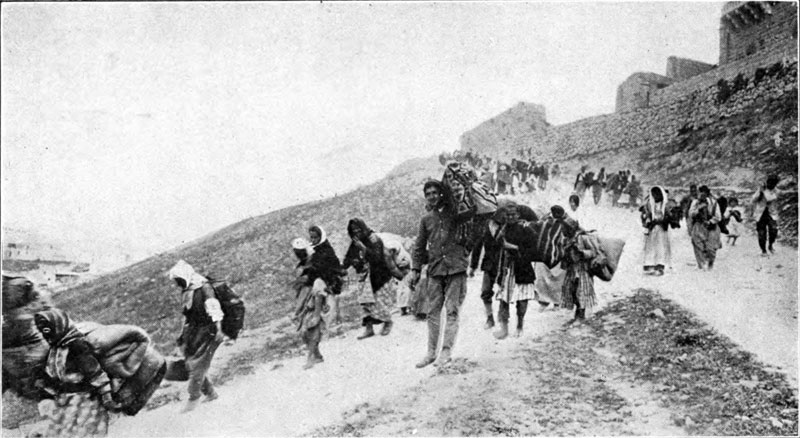
After the arrest and execution of the intellectuals in April 1915, ordinary Armenians were turned out of their homes and sent on death marches through the Mesopotamian desert without food or water. The Armenians were marched out to the Syrian town of Deir ez-Zor and the surrounding desert. There is no evidence that the Ottoman government provided the extensive facilities and supplies that would have been necessary to sustain the life of hundreds of thousands of Armenian deportees during their forced march to the Syrian desert or after. By August 1915, The New York Times repeated an unattributed report that "the roads and the Euphrates are strewn with corpses of exiles, and those who survive are doomed to certain death. It is a plan to exterminate the whole Armenian people".] Talaat Pasha and Djemal Pasha were completely aware that by abandoning the Armenian deportees in the desert they were condemning them to certain death. A dispatch from a "high diplomatic source in Turkey, not American, reporting the testimony of trustworthy witnesses" about the plight of Armenian deportees in northern Arabia and the Lower Euphrates valley was extensively quoted by The New York Times in August 1916
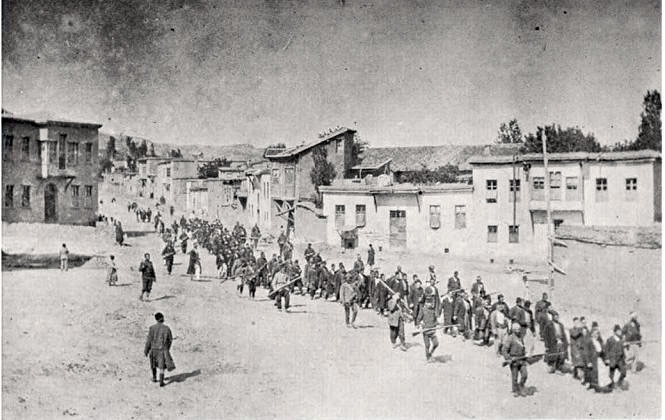
Muslim families moved into the homes of deported Armenians and seized their property. In 1922, when the genocide was over, there were just 388,000 Armenians remaining in the Ottoman Empire. After the Ottomans surrendered in 1918, the leaders of the Young Turks fled to Germany, which promised not to prosecute them for the genocide. Ever since then, the Turkish government has denied that a genocide took place. The Armenians were an enemy force, they argue, and their slaughter was a necessary war measure.
:It is difficult to research the issue of the genocide, because of the strong feelings held by both sides today. But whatever way I look at it, over 1.5 million Armenians disappeared from Turkey, most of them being killed by the state through execution or starvation. It is difficult to accept that the Turkish government was justified in doing this because it was concerned that the Armenians would join an armed fight against the Turkish Government during the time of war.