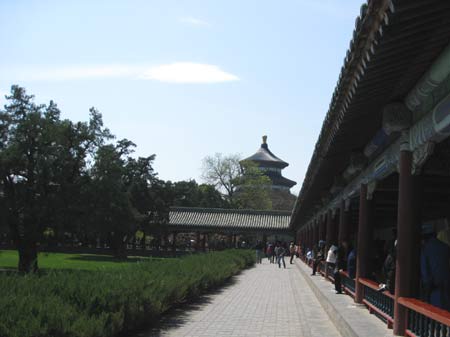
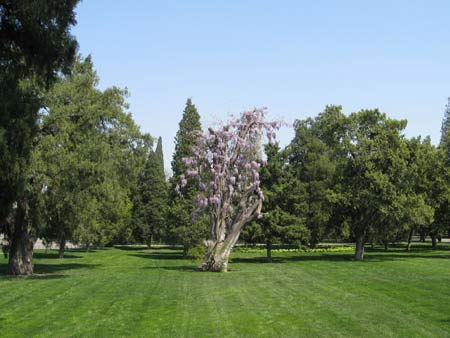
The temple complex was constructed between 1406 and 1420 during the reign of the Yongle Emperor, who was also responsible for the construction of the Forbidden City in Beijing. The complex was extended and renamed Temple of Heaven during the reign of the Jiajing Emperor in the 16th century. The Temple of Heaven was renovated in the 18th century under the Qianlong Emperor.
The Temple of Heaven, literally in Chinese the Altar of Heaven, is a complex of Taoist buildings situated in southeastern urban Beijing, in Xuanwu District. The complex was visited by the Emperors of the Ming and Qing dynasties for annual ceremonies of prayer to Heaven for good harvest. It is regarded as a Taoist temple, although Chinese Heaven worship, especially by the reigning monarch of the day, pre-dates Taoism.
The Temple of Heaven was inscribed as a UNESCO World Heritage Site in 1998 and was described as "a masterpiece of architecture and landscape design".
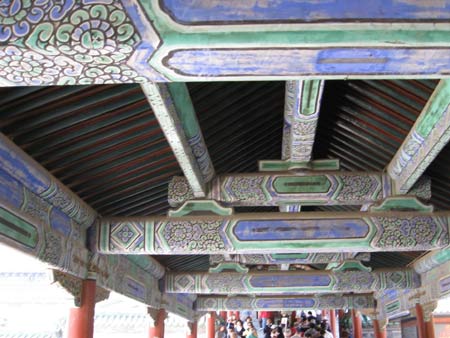
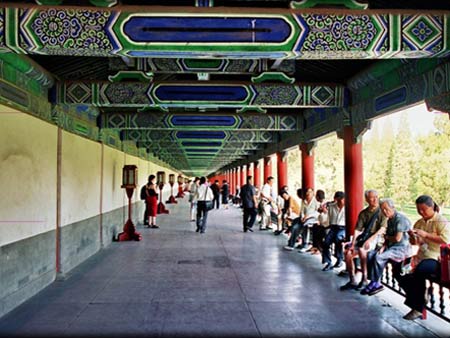
Around 12 million Chinese visit the temple every year, and we found it as much a social as a cultural attraction. The locals sat along the approach corridor and sang, knitted, talked or watched buskers.
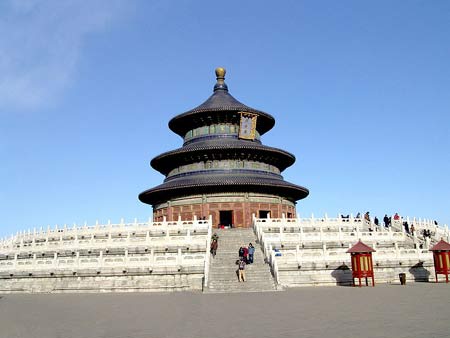
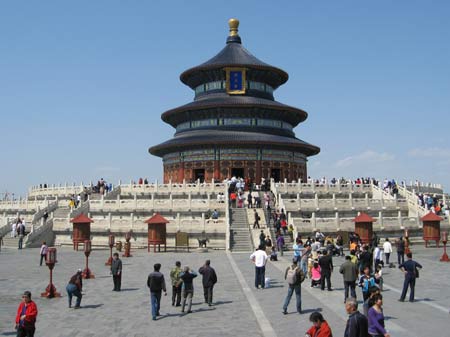
The crowds come and go round the Temple itself during the day. It is a particularly attractive building, with marvelous symmetry.
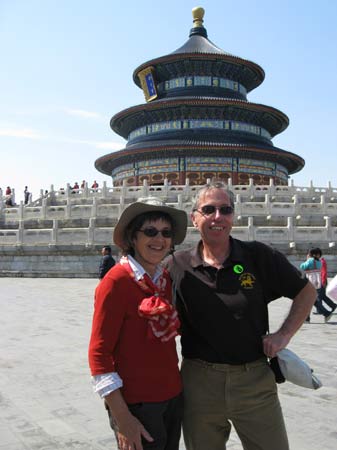
We quite got into the Chinese custom of having our photos taken against the background of whatever we were visiting.
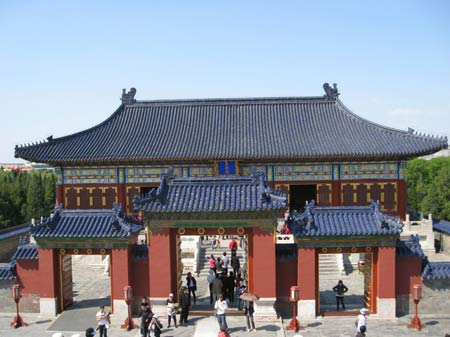
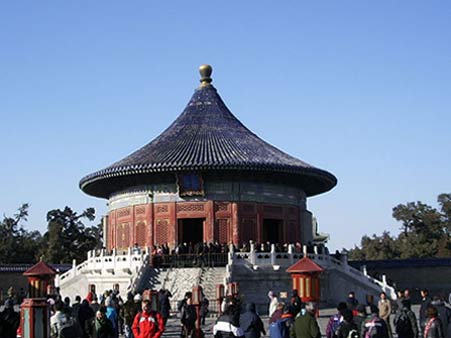
The Imperial Vault of Heaven is a single-gabled circular building, built on a single level of marble stone base. It is south of the Hall of Prayer for Good Harvests and resembles it, but is smaller. It is surrounded by a smooth circular wall, the Echo Wall, that can transmit sounds over large distances. The Imperial Vault is connected to the Hall of Prayer by the Vermilion Steps Bridge, a 360 meter long raised walkway that slowly ascends from the Vault to the Hall of Prayer.
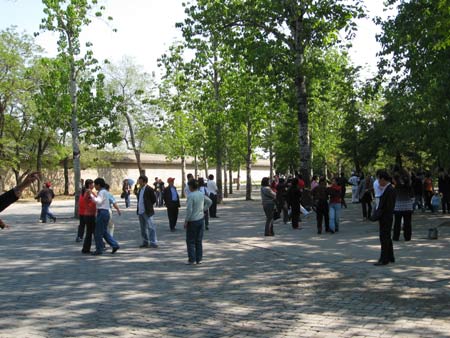
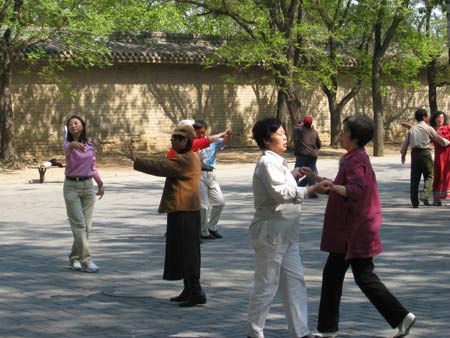
And in the grounds hundreds of Chinese practice yoga and, oddly, ballroom dancing.
That was the end of our touring of Beijing. Back on the Volendam, we made for Dalian, another Chinese port.