
A Tarsier - I am proud of this photo !
Sunday December 14. Bohol Island,
We berthed at the port of Tagbilaran around 8 am and went ashore and boarded three buses.
A Tarsier comes from any of about 13 species of small leaping primates found only on various islands of Southeast Asia, including the Philippines. Tarsiers are intermediate in form between lemurs and monkeys, measuring only about 3.5–6 inches long, excluding a tail of about twice that length. Known for its distinctive large eyes that are proportionally bigger than its brain. These ancient creatures have been around for approximately 45 million years and are considered a potential evolutionary link between lemur-like animals and humans. Tarsiers belong to the family Tarsiidae and are characterized by their unique physical adaptations, including elongated leg bones and the ability to rotate their heads nearly 180 degrees. They are the only carnivorous primates, primarily consuming insects but also preying on small birds and reptiles.
Our bus took us to the tarsier sanctuary where we saw a brief video on these minute mammals, then had some refreshments including ginger juice, before entering the sanctuary in a group of about 15. We were super quiet and proceeded to 3 places where there was a tarsier in the trees: at the first two we gave our cameras or phones to an employee who took a picture of this minute mammal, similar to a lemur or a small monkey, hidden up high between the leaves. Most of the people could just see these this animal. At the third stop David took the photos and these were the best we had and he could see the mammal quite clearly.

To get a larger photo, click on a thumbnail below
 |
 |
 |
 |
| We go to the Tarsier sanctuary | Pembroke was on the lookout for the little fellows | But could not find them in the thick jungle | |
 |
 |
 |
 |
| Eventually we found 3 tarsiers | They are very shy and difficult to photograph |
We then walked the 10 minutes back to the bus and proceeded to the Church of the Lady of Guadalupe. This was a second oldest church on Bohol, but had been severely damaged in the earthquake of 2013 and was flooded almost every year. However it had been restored by 2021 by the Philippine government. We walked round the town square here where there was a statue of a Philippine national hero. It portrays Dr. Jose Rizal in an overcoat, holding a book to represent his seminal novels, Noli Me Tángere and El Filibusterismo, which played pivotal roles in the Philippine fight for independence from Spanish rule.
To get a larger photo, click on a thumbnail below
 |
 |
 |
 |
 |
 |
 |
 |
 |
 |
 |
 |
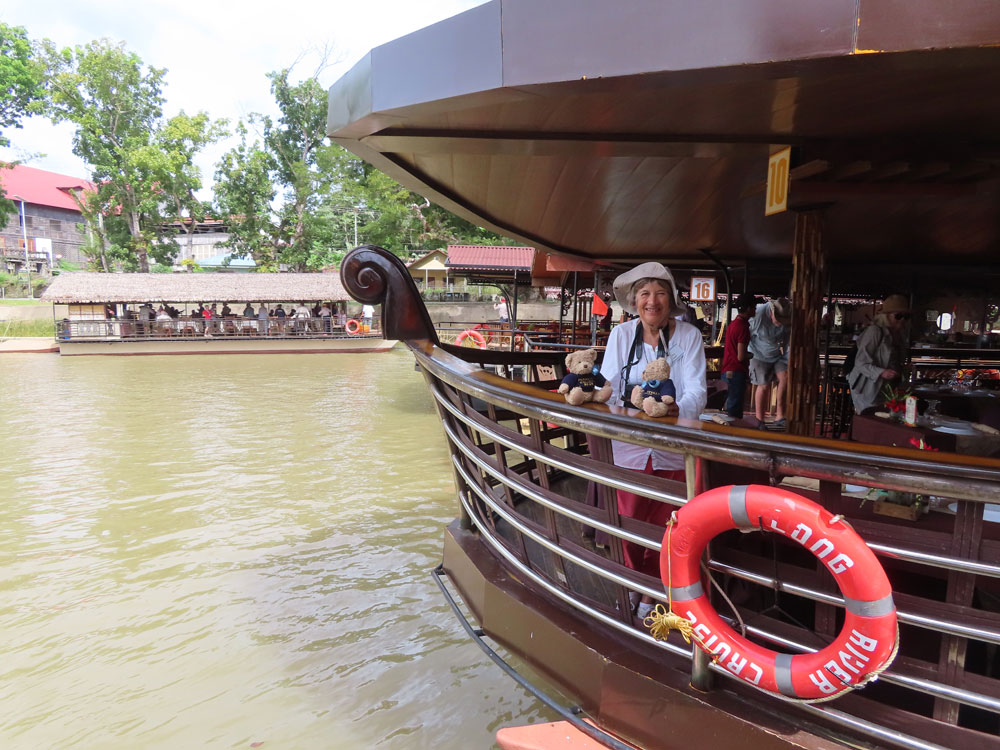
Then on to lunch on a boat on the River Loboc. The buffet here was quite reasonable and the place settings were quite elegant too. Once lunch started, the boat moved down river for 2 km and we stopped beside some dancers on the bank who executed their marvelous national dance, Tinikling, The dance requires precise, fast-paced footwork as dancers step in and out of the rhythmically clapping bamboo poles, mimicking the movement of a local bird called the tikling. This bird is known for its ability to walk between grass stems, run over tree branches, and dodge bamboo traps set by rice farmers.

To get a larger photo, click on a thumbnail below
 |
 |
 |
 |
 |
 |
 |
 |
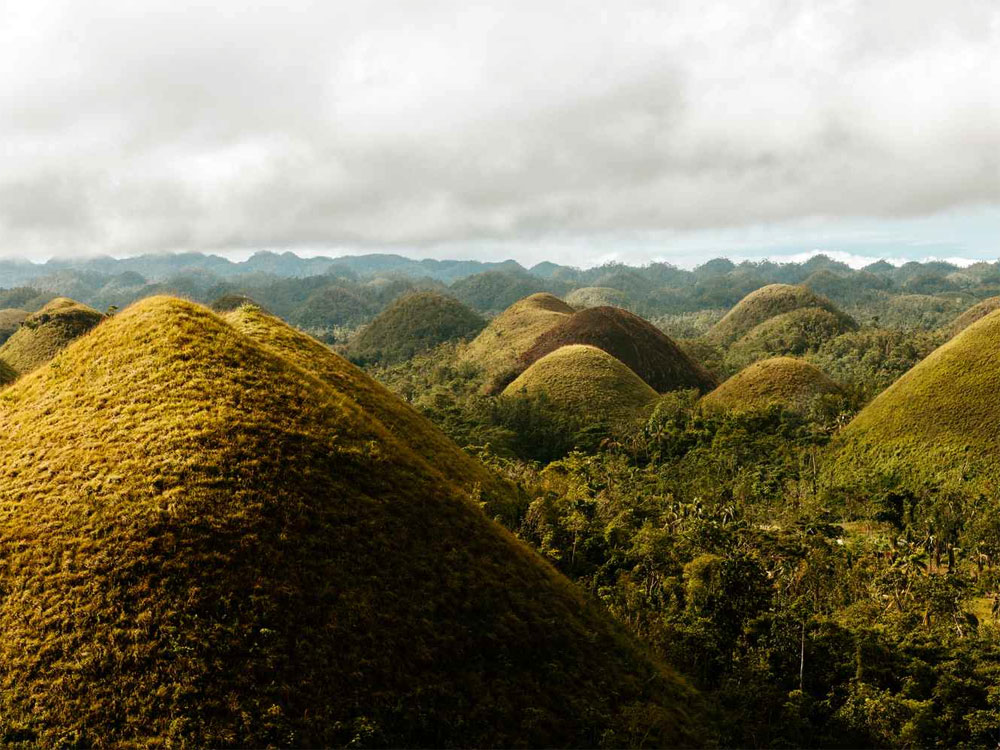
Returning to base we proceeded to The Chocolate Hills, A geological formation consisting of about 1300 conical shaped hills. We climbed 214 steps, Chris having severe difficulties with the steps, to reach the viewing platform where The Hills stretched out in all directions with Paddy fields visible as well. During summer, the grass covering the hills turns brown making the hills chocolate coloured.
To get a larger photo, click on a thumbnail below
 |
 |
 |
 |
 |
 |
 |
 |
After this, it was a 75 minute ride in the coach back to the ship which we reached just before 4:30 pm. We showered and enjoyed a French martini cocktail before the 6:15 pm briefing and then a buffet Filipino supper, followed by a David Attenborough film on the deep oceans.
