
1872 Oct 25 . Born London. His father was a Barrister
1881 census with his parents at 38 Eaton Square, London

1891 census he was a Boarder at RMA, Woolwich
1892 Jul 22 Commissioned 2nd Lt in RE
1895 Jul 22 Promoted Lt in RE
1900 Jan 4. Left Chatham for South Africa.
The 9th Field Company was ordered to join the South African Field Force and on the 4th of January 1900 the unit left Chatham for Southampton. On the following day the company sailed from Southampton aboard the Union Line troopship Goorkha bound for Cape Town where it would become part of the 7th Infantry Division. The officers of the 9th Field Company at the time of its deployment to South Africa were: ....Lieutenant Alexander Hardcastle: Section Officer, No. 2 Section
1901 census a Lt in Royal Engineers at Lydd, Kent
1903 Jul 22. Promoted Capt in RE
1907 Jul 24 Retires on retired pay
1911 census He is not with his parents, nor can I find him elsewhere in UK
Re-employed in the Great War, 1914-1917 (I cannot find evidence of this in LG.. And 1915, 1916 and 1917Army list has him among the retired officers)
1918 Nov. Army List shows him as Reserve of Officers employed RE. He did not serve overseas so it maybe that he was employed in an administrative post somewhere.

1920 Dec Hardcastle moved to Girgenti (now Agrigento), where he purchased a new house, the Villa Aurea , and allocated private funds to perform excavations and massive renovation works at the nearby Greek temples of Akragas . In particular, he restored eight columns of the Temples of Herakles and Demetra , and excavated part of the ancient city walls in the 1920s. His activity caused a great sensation in both Sicily and Great Britain. The London Illustrated carried regular articles on his work in Italy.
He had decided to take off for Italy with his witty but hapless younger brother, Henry Robert Hardcastle, to keep him company (his brother was a clergyman, and died in UK in 1956). He had never been to Sicily before and spoke no Italian, but immediately liked what he saw. Within four months, he had bought his home and named it after the fourth gate into the Valley site. From the windows of what would become his sitting room, there were grandstand views hardly to be believed: to the left stood the Temple of Concordia intact, while to the right was one single Doric column still upright of the 6th century BC remains of the Temple of Herakles.
Within weeks of the house purchase, he wrote to the Central Department of Fine Arts in Rome offering to part-finance out of his own pocket, no strings attached, the resurrection of three or four of the 33-foot high fallen columns of the Temple of Herakles. Rome rarely received such letters, but such an offer was not to be lost in the bureaucratic shuffle and they speedily consented. The remaining prone columns soon followed, this time wholly at the Captain’s expense. Before long, all eight pillars were upright, handsomely aligned, a new spectacle to delight the visitors, as they still do.

1922 Oct 25. The undermentioned having attained the age limit of liability to recall, cease to belong to the Res. of Off. 25th Oct. 1922: : — ... Capt. A. Hardcastle.
1928 May 8 . London Gazette . Whitehall, May 16, 1928.The KING has been pleased to give and grant unto Captain Alexander Hardcastle His Majesty's Royal licence and authority to wear the Insignia of Commander of the Orderof the Crown of Italy, which Decoration has been conferred upon him by His Majesty the King of Italy, in recognition of valuable services rendered by him. The title of Commendatore della Corona d’Italia was conferred on him by Italy in tribute to the work that he conducted both in Sicily and in Lazio’s Etruria area.
1929. Hardcastle’s endeavours continued year after year throughout the 1920s until one event occurred, affecting the whole world, himself included: the 1929 stock market crash on Wall Street. Suddenly, his projects slowed to a trickle. His bank in England collapsed and his entire wealth evaporated. In desperation, he sold off what he could – a car here, a riding horse there – to fund more modest initiatives. Local friends advanced him what they could. But they, too, were in a precarious situation. Hardcastle and his brother stumbled along as best they could. But the strain eventually wore him down and his mental faculties abandoned him completely. He was admitted to the local insane asylum and administered the prevalent quackeries of the times. But nothing seemed to work and in June 1933, aged 60, he died.
1933 June 27. Died Agrigento, Sicily
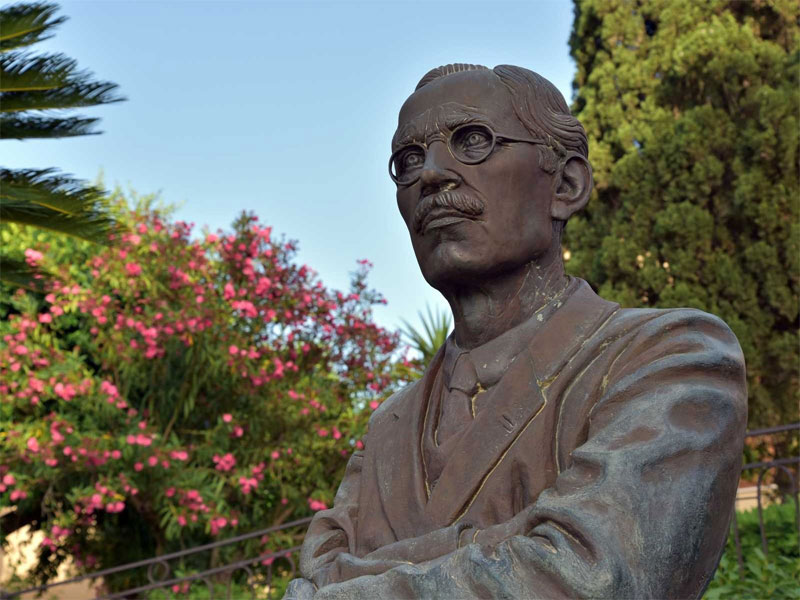
There is his simple grave in a far corner of the Bonamorone Cemetery on the Via Demetra in Agrigento, where a ceremonial bouquet has been place regularly every June since his death.

2010 Nov 29. Daily Telegraph . ....Hardcastle, a former soldier who had served with the Royal Engineers in the Boer War, believed that remains of the stone-built theatre had survived, despite Akragas being shaken by earthquakes, sacked by the Carthaginians and plundered for its stone...... He had achieved a restoration of the city, partly rebuilding temples, uncovering perimeter walls and clearing ancient roads, but found no trace of the legendary theatre. Now a team of archaeologists is to resume the hunt, embarking in the next few months on a dig that will be funded by a two million euro grant from the European Union. The team will be led by Giuseppe Castellana, 64, the director of the Valley of the Temples Archeological Park. "We want to resume the research started by Alexander Hardcastle in the coming months. It will be a way of honouring his memory," ... Prof Castellana, who has been involved in more than 80 digs over the last 30 years, told La Stampa newspaper. "The discovery would go down in history and it would also benefit the modern city of Agrigento, which needs to survive on archaeological tourism but hasn't managed to make the most of its enormous potential," he added. Akragas was described by the ancient Greek poet Pindar as "the most beautiful city in the world inhabited by mortals" and scholars think it highly likely that it would have boasted a theatre. The archaeologists also hope to unearth evidence of a hippodrome, a stadium for horse and chariot racing. Excavations were carried out at the site in the 1970s and 1980s but archaeologists found no evidence of the theatre or hippodrome.