
Iceland Flag
Although not that far from Alicante, Reykjavik is a real pig to get to. The only reasonable flight left LHR ar around 08.00. This meant driving to Alicante the night before, catching an O'Leary special to LGW, getting a National Express to LHR, getting to the Hilton at T4, and next morning getting the bus to T5 for our flight to Reykjavik. Our first nights were in Reykjavik before boarding Silver Wind
Iceland is a Nordic island country in the North Atlantic, with a population of 348,580 and it is the most sparsely populated country in Europe. The capital and largest city is Reykjavík. Reykjavík and the surrounding areas in the southwest of the country are home to over two-thirds of the population. Iceland is volcanically and geologically active. The interior consists of a plateau characterised by sand and lava fields, mountains, and glaciers, and many glacial rivers flow to the sea through the lowlands. Iceland is warmed by the Gulf Stream and has a temperate climate, despite a high latitude just outside the Arctic Circle. Its high latitude and marine influence keep summers chilly, with most of the archipelago having a tundra climate.
According to the ancient manuscript Landnámabók, the settlement of Iceland began in 874 AD when the Norwegian chieftain Ingólfr Arnarson became the first permanent settler on the island. In the following centuries, Norwegians, and to a lesser extent other Scandinavians, emigrated to Iceland, bringing with them thralls (i.e., slaves or serfs) of Gaelic origin. The island was governed as an independent commonwealth under the Althing, one of the world's oldest functioning legislative assemblies. Following a period of civil strife, Iceland acceded to Norwegian rule in the 13th century. The establishment of the Kalmar Union in 1397 united the kingdoms of Norway, Denmark, and Sweden. Iceland thus followed Norway's integration to that union and came under Danish rule, after Sweden's secession from that union in 1523.
Although the Danish kingdom introduced Lutheranism forcefully in 1550, Iceland remained a distant semi-colonial territory in which Danish institutions and infrastructures were conspicuous by their absence. In the wake of the French Revolution and the Napoleonic Wars, Iceland's struggle for independence took form and culminated in independence in 1918 still under the Danish King. The British invaded Iceland during WW2 . And the founding of a republic was in 1944.
Until the 20th century, Iceland relied largely on subsistence fishing and agriculture, and was among the poorest countries in Europe. Industrialisation of the fisheries and Marshall Plan aid following World War II brought prosperity, and Iceland became one of the wealthiest and most developed nations in the world. In 1994, it became a part of the European Economic Area, which further diversified the economy into sectors such as finance, biotechnology, and manufacturing.
From LGW to LHR There was a bit of a to-do on the National Express bus, when a large plastic panel in the room fell down on Chris's head. We informed the driver at the next stop (he should have seen it happen anyway) but the said surly driver wa unconcerned, saying his job was to drive the bus, and was not responsible for the maintenance thereof.
Click on any of the thumbnails to get a bigger version of the picture
 |
 |
 |
 |

Click on any of the thumbnails to get a bigger version of the picture
 |
 |
 |
 |
 |
 |
 |
 |
We needed a hotel at Heathrow. as our flight left at 8am. The Hilton was a good choice. It is within a short walk of Terminal 4 along about 400 meters of covered walkway.
The check in and check out were pleasant and efficient.
We had an Executive room, which is worth the extra, particularly if you can get a good online deal. You get access to their excellent Executive lounge with tapas and free drinks from about 6.30 to 8.30 in the evening. The lounge was stylish but it was extremely busy and not easy to find a seat. And you can get breakfast in the morning - though it does not open that early and we had to leave before it opened.
The bedroom was modern, and quiet. Ours opened onto the central atrium (as about half the rooms do).
Not a hotel you would want to stay in for more than the overnight stop, but a real find as a Heathrow hotel, and we will certainly stay there again if we need to overnight at Heathrow
Click on any of the thumbnails to get a bigger version of the picture
 |
 |
 |
 |
Happily we were traveling Business Class. So breakfast at the T4 BA Business lounge, which is better than any of the newly sprung up "pay to enter" versions in airports around the world. Personally I don't rate business class travel, but Chris and the Boyzz insist on it and it does mean I get a glass of wine with my breakfast.
Landing in Iceland, we took the airport bus for the hour's drive into Reykjavik, then changed for a smaller bus at the bus station on the edge of town - Reykjavik bans the big tourist buses from the city centre
Getting to the hotel around 11am, it was not surprising that our room was not ready, so we left our bags and walked around Reykjavik. This was the first of a number of strolls around the town. I was not too impressed by the town on first glance, but it sort of grew on me, and once you get away from the tourist tat, there are many interesting side streets. Did I say tourist tat, Reykjavik is sinking under the weight of tourism. All shops are selling tourist stuff, and most of the locals have moved to the suburbs.
The first thing you learn is that Iceland is seriously expensive. Due to the exchange rate of the Icelandic Kronor, everything is nearly twice the rate of other countries - even takeaway fish and chips from a roadside van was 20 euros a portion

Click on any of the thumbnails to get a bigger version of the picture
 |
 |
 |
 |
 |
 |
 |
 |
 |
 |
 |
 |
 |
 |
 |
 |
 |
 |
Museums.
We went to the Saga Museum which I though was a sad tawdry tourist trap. One of the worst "museums" that I have ever visited. They get customers through extensive marketing. but when you get there is is a sad waxwork exhibition that you walk round with a headset to give a commentary. The wax figures are past their prime, the commentary is not particularly informative The museum is expensive (even by Icelandic standards). Save your money and go to one of the many better museums, like the other two we saw.
The Settlement Museum - an excellent archeological museum, The museum is devoted to explaining the remains of a long house some 1000 years old - they can date it from the evidence of known volcanic eruptions The remains of the long house are 4 or 5 meters below street level. The room is in darkness and there are interactive displays that light up to explain what the building was all about. At the end of an hour or so, I felt that I knew how the original settlers built their houses and farmed their land. It was much better than the Saga Museum - in a different class.
The Maritime Museum - if you want to know about Iceland's cod fish industry, then this is the place to come. Iceland's economy was built on fishing - though today tourism is more important. This modern museum offers an insight into how they have caught deep sea fish over the years, and how they saw off the British during the "Cod Wars". You can also visit the fishery protection vessel Odin - but visits are limited to tours at particular time, so if you want to go round the Odin, you need to check the times for the ship; we missed out on going round it. I felt that I came out of the museum knowing a lot more about the fishing industry in Iceland.
Click on any of the thumbnails to get a bigger version of the picture
 |
 |
 |
 |
 |
 |
 |
 |
 |
 |
 |
|
 |
 |
 |
 |
Thingvellir is a national park about 40 km northeast of Reykjavik. The park lies in a rift valley that marks the crest of the Mid-Atlantic Ridge and the boundary between the North American and Eurasian tectonic plates. To its south lies Thingvallavatn, the largest natural lake in Iceland. Thingvellir is associated with the Althing, the national parliament of Iceland, which was established at the site in 930 AD. Sessions were held at the location until 1798.
According to the Book of Settlements, the settlement of Iceland began in AD 874 when the Norwegian chieftain Ingólfr Arnarson became the first permanent Norwegian settler on the island. Over the next centuries, people of Norse and Celtic origin settled in Iceland. Early on, district assemblies were formed, but as the population grew, there was a need for a general assembly. The foundation of the Icelandic parliament is said to be the founding of the nation of Iceland, and the first parliamentary proceedings in the summer of 930 laid the ground for a common cultural heritage and national identity.
Every year during the Commonwealth period, people would flock to Thingvellir from all over the country. They set up temporary dwellings with walls of turf and rock and temporary roofing of homespun cloth, and stayed in them for the two weeks of the assembly. There were no permanent buildings at Thingvellir.
In the final decades of the Commonwealth, there were clashes between chieftain families, which resulted in Iceland coming under the Norwegian crown. Executive power was strengthened under this new order, while legislative and judicial authority was gradually transferred to the Norwegian and later the Danish rulers, until in 1662, the King of Denmark became the absolute monarch of Iceland.

Click on any of the thumbnails to get a bigger version of the picture
 |
 |
 |
 |
 |
 |
 |
 |
 |
 |
 |
 |
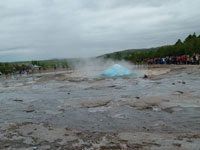
Then on to the Geysers. Though not as famous as the Great Geysir, which is now dormant following an earthquake in 2000, we visited Strokkur. Strokkur expels steaming hot water every 8 to 10 minutes, so you will see it erupt several times on your visit. Stand by and watch the water gurgle and boil right before it surges upwards. It is on the Golden Circle and in Haukadalur Valley.
Strokkur’s eruptions can measure up to 40 meters high, though due to their frequency many are much smaller. The average eruption is 15 to 20 meters. The surrounding Haukadalur valley area is full of other geological delights, from mud pools to fumaroles, which are openings in the Earth’s crust where steam and gases are emitted. Strokkur stopped erupting for a time after an earthquake in the early 20th century. In 1963, a blocked conduit was cleaned out and this geyser in Iceland has been erupting since! ‘Strokkur’ is the Icelandic word for ‘churn’.

Click on any of the thumbnails to get a bigger version of the picture
 |
 |
 |
 |
 |
 |
 |
 |
 |
 |
 |
 |
 |
 |
 |
 |
 |
 |
Gullfoss waterfall

Gullfoss (Golden Waterfall) is an iconic waterfall of Iceland offering a spectacular view of the forces and beauty of untouched nature. Gullfoss is part of the Golden Circle tour and on the Hvítá (White) river which is fed by Iceland´s second biggest glacier, the Langjökull. The water plummets down 32 meters in two stages into a rugged canyon, which walls reach up to 70 meters in height.
In the early 20th century foreign investors wanted to harness the power of Gullfoss to produce electricity. In 1907 Howells, an Englishman, leased the waterfall from a local farmer. The farmer´s daughter, Sigriður Tómasdóttir, who grew up on her father´s sheep farm, sought to have the rental contract voided. Sigriður, using her own savings, hired a lawyer in Reykjavik to defend her case. The trial lasted years. Her attempts failed in court but before any damage was done to the waterfall the contract was voided due to the lack of payments of the rent fee. In 1940 the adopted son of Sigriður acquired the waterfall from Sigriður´s father and later sold it to the Icelandic government. Gullfoss and its environs was designated as a nature reserve in 1979, permanently protecting the waterfall and allowing the public to enjoy this unique area.
Click on any of the thumbnails to get a bigger version of the picture
 |
 |
 |
 |
 |
 |
 |
 |
 |
 |
 |
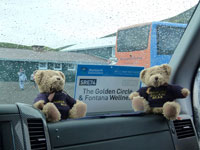 |
Laugarvatn Fontana Hot Springs

We opted for this rather than the Blue Lagoon, as the Blue Lagoon appears to have become oversubscribed by tourists. In the end we were not sure whether we had made the right choice. Fontana Springs was past its prime!
The bread making demonstration was very good and was memorable. A sealed pot of barley bread dough is buried in the hot volcanic earth, and 24 hours later it is dug up. I enjoyed both the concept and the eating with lots of butter - though unfortunately the "lots of butter" was spotted by the management
Chris thought that the spa pools were indifferent, and that they did nothing to blend in with nature.
Click on any of the thumbnails to get a bigger version of the picture
 |
 |
 |
 |
 |
 |
 |
 |
 |
 |
 |
 |
Laekjarbrekka Restaurant & Fish and Chips on the quay
We chose to eat at the Laekjarbrekka Restaurant because it was one of a handful of old buildings still standing in Reykjavik. And because it appeared to be well written up for its food. It is centrally situated, so you don't have to walk too far to get to it.
They offer online table reservations, and it is worth doing that as it is not large inside. If you can get a window tabl, e as we did, then you can people watch as the crowds amble by on the main shopping street
Like all restaurants in Iceland it is expensive, But by local standards offers good value for money.
Their fish is good, as it should be.
I was not too impressed by our dessert, which was meant to include raspberries (plural) but when it arrived only had one lonely berry. Did not impress Chris!
Next night we had a fish and chips from the eponymous van on the quay, right by where Silver Wind was moored.

Click on any of the thumbnails to get a bigger version of the picture
 |
 |
 |
 |
 |
 |
 |
 |
 |
 |
Reykjavik Residence Hotel
We stayed for two nights in a studio apartment, with sloping roof and a small kitchen. Like everything in Iceland, the hotel is expensive (it is all down to exchange rate) but offers very good value for money. I think you would be pushed to get better value for money in Reykjavik.
The hotel has a lot of rooms spread over a number of nearby buildings, so you need to check exactly where your room is. Ours was upstairs in the main building. There is a lot of construction in the city at the moment, and although there was construction going on opposite, it did not intrude.
The kitchen comes with a basic starter kit of juice, milk, cornflakes and a coffee capsule machine with more capsules than you could ever use. The heating (the city is on underground thermal water) is very efficient and keeps your room very warm
The staff are particularly welcoming and helpful with advice We did not take the hotel breakfast, but made our own in the apartment kitchen.

Click on any of the thumbnails to get a bigger version of the picture
 |
 |
 |
 |
 |
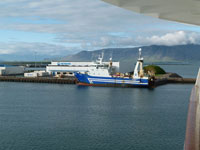
Next morning we decided to walk to Silver Wind, having ascertained that we could get on board at noon. It was only marginally further than going in the other direction to pick up Silversea transport, and it enabled us to choose our own time of boarding. So lunch on board on the pool deck, afternoon tea and then it was time to sail out of Reykjavik harbour for our next Icelandic port - Isafjordur
Click on any of the thumbnails to get a bigger version of the picture
 |
 |