 |
 |
|
|
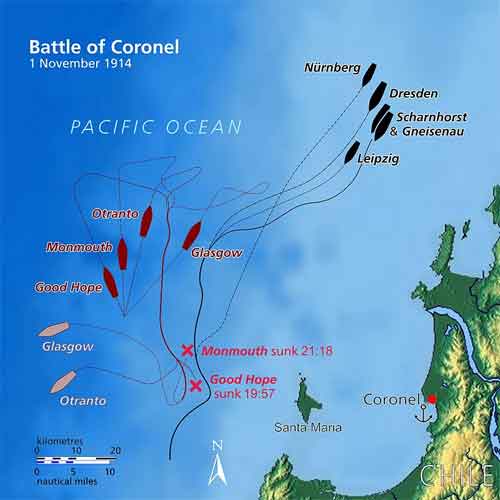
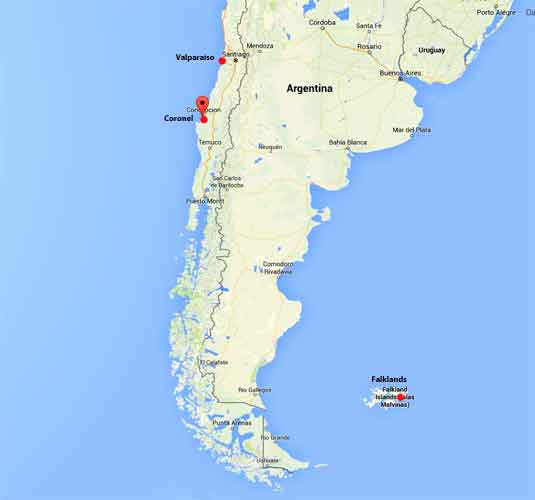
The First World War naval Battle of Coronel took place on 1 November 1914 off the coast of central Chile near the city of Coronel. German Kaiserliche Marine forces led by Vice-Admiral Graf Maximilian von Spee met and defeated a Royal Navy squadron commanded by Rear-Admiral Sir Christopher Cradock. The engagement probably took place as a result of a series of misunderstandings. Neither admiral expected to meet the other in full force.
Once the two met, Cradock understood his orders were to fight to the end, despite the odds heavily against him. Although Spee had an easy victory, destroying two enemy armoured cruisers for just three men injured, the engagement also cost him almost half his supply of ammunition, which was impossible to replace. Shock at the British losses led to an immediate reaction and the sending of more ships which in turn destroyed Spee and the majority of his squadron at the Battle of the Falkland Islands.
The British had captured the German colonies in Asia of Kaiser-Wilhelmsland, Yap, Nauru and Samoa early in the war. Vice-Admiral Maximilian von Spee's German East Asia Squadron had abandoned its base at the German concession at Tsingtao in China once Japan entered the war on Britain's side.
On 5 October, the British learned from an intercepted radio communication of Spee's plan to prey upon shipping in the crucial trading routes along the west coast of South America. Patrolling in the area at that time was Rear-Admiral Sir Christopher Cradock's 4th Cruiser Squadron. Cradock's force was to have been reinforced from Mediterranean waters by the newer and more powerful armoured cruiser HMS Defence, but ultimately this ship was diverted, the old pre-dreadnought battleship HMS Canopus being ordered to join him instead. The last-minute change in plans meant that the British squadron was composed almost entirely of either obsolete or under-armed vessels, all these crewed by inexperienced naval reservists being the conventional wisdom. However in fact only 10% of Monmouth's crew and 50% of Good Hope's crew were reservists (from casualty lists). It appears to me it was the RN ships that were the problem, not the crews. The ships were bound to be defeated. They were old, slow, and did not have big enough guns.
Cradock therefore joined battle with:-
In contrast, von Spee had a formidable force of 5 modern ships which were faster
Nevertheless, Cradock was ordered simply to "be prepared to meet them in company" with no effort made to clarify what action Cradock was expected to take, should he find von Spee. Cradock's west coast squadron was reinforced by HMS Canopus which finally arrived on 18 October. Reprieved from its scheduled scrapping by the outbreak of war and badly in need of an overhaul, her top speed was only 12 knots , or about two-thirds her design speed and just over half that of the remainder of the squadron. The Admiralty recognised that her slow speed meant the fleet would not be fast enough to force an engagement and also that without the Canopus the fleet stood no chance against von Spee. Cradock was told to use Canopus as "a citadel around which all our cruisers in those waters could find absolute security" or in other words, keep contact with von Spee while avoiding any risky engagements.
On 31 October, Glasgow entered Coronel harbour to collect messages and news from the British consul. Also in harbour was a supply ship—Göttingen—working for Spee, which immediately radioed with the news of the British ship's entering harbour. Glasgow meanwhile was listening to radio traffic, which suggested that German warships were close. Matters were confused, because the German ships had been instructed to all use the same call sign, that of Leipzig. The result was that Admiral Cradock hurried north to catch what he thought was the solo Leipzig. Von Spee, having learned of the presence of Glasgow off Coronel, sailed south from Valparaíso with all five warships with the intention of destroying Glasgow. Neither side realised the other's main force was nearby.
At 09:15 on 1 November, Glasgow left port to meet Cradock at noon, 40 mi west of Coronel. At this stage it is probable that the British force could have escaped by sailing towards Canopus, then some 300 miles to the south; with the failing light Spee would most likely have lost contact with the British squadron. Instead Cradock chose to stay and fight; however he ordered Otranto to break formation and flee.
At 13:50, the British ships formed into a line of battle 15 mi apart and started to steam north at 10 kn searching for Leipzig
16:17, The German ships spotted smoke from the British line, Spee expecting only the Glasgow. Von Spee ordered full speed so that Scharnhorst, Gneisenau and Leipzig were approaching the British at 20 kn, with the slower light cruisers Dresden (there is a good map of Dresden's movements after Coronel on this link) and Nürnberg some way behind
So both sides are thought to have expected to encounter a single ship until they sighted each other. There was then a sea battle that lasted only about 4 hours. The British were outgunned and outranged by the bigger, more numerous German guns and better trained gunnery crew.
A few hours later Monmouth and Good Hope had both sunk with no survivors. 1,600 British officers and men were dead with Cradock among them. Glasgow and Otranto both escaped (the former suffering five hits and five wounded men). Bizarrely when he had left the Falklands some weeks earlier, Cradock had left behind a letter to be forwarded to Admiral of the Fleet Sir Hedworth Meux in the event of his death. In this, he commented that he did not intend to suffer the fate of Rear-Admiral Troubridge, who had to be court-martialed, in early November, for failing to engage the enemy, despite the odds being against him, during the pursuit of Goeben and Breslau, in August. In Troubridge's case, the German ships had slipped past him and escaped, and it was possible that von Spee might do the same, rounding the Horn and heading for Germany if Cradock did not intervene. The governor of the Falklands reported that Cradock had not expected to survive, as did the governor's aide, Luce , who reported that "Cradock was constitutionally incapable of refusing or even postponing action if there was the smallest chance of success".
Just two British shells had struck Scharnhorst, neither of which exploded: one 6-inch shell hit above the armour belt and penetrated to a storeroom. Another struck a funnel. In return, Scharnhorst had managed at least 35 hits on Good Hope, but at the expense of 422 of its 8 in shells, leaving her with 350. Four British shells had struck Gneisenau, one of which nearly flooded the officers' wardroom. A shell from Glasgow struck her after turret and temporarily knocked it out. Three of Gneisenau 's men were wounded; she expended 244 of her shells and had 528 left.
On 3 November, Scharnhorst, Gneisenau and Nürnberg entered Valparaiso harbour and were welcomed as heroes by the German population. Von Spee, despite his victory, was pessimistic with regard to the real harm done to the British navy, and also to his own chances of survival. Von Spee refused to join in the celebrations; presented with a bunch of flowers he commented, "these will do nicely for my grave". He was to die with most of the men on his ships approximately one month later at the Battle of the Falkland Islands, on 8 December 1914.
On 4 November, German reports of the battle started to reach London.
A new naval force was assembled under Vice-Admiral Sturdee. This found and destroyed Spee's force at the Battle of the Falkland Islands on 8 Dec 1914
 |
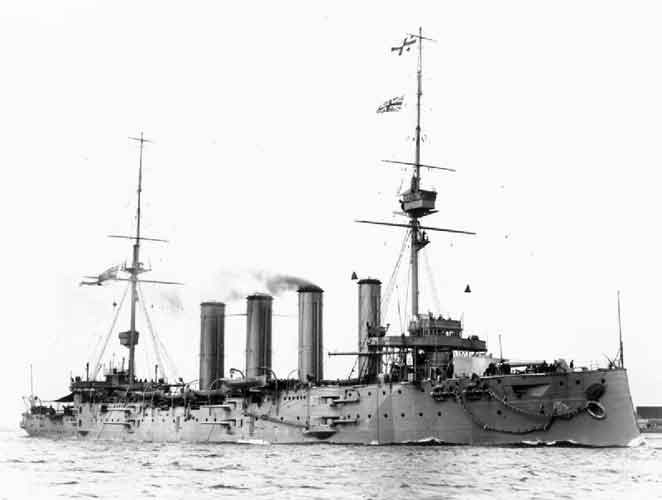 |
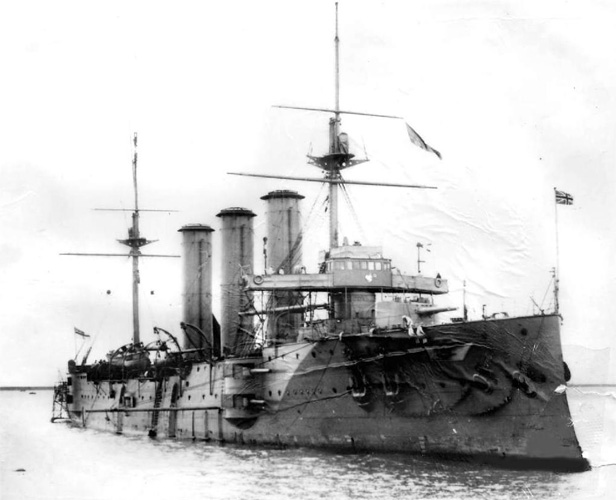
| HMS Monmouth | HMS Good Hope |
Against
 |
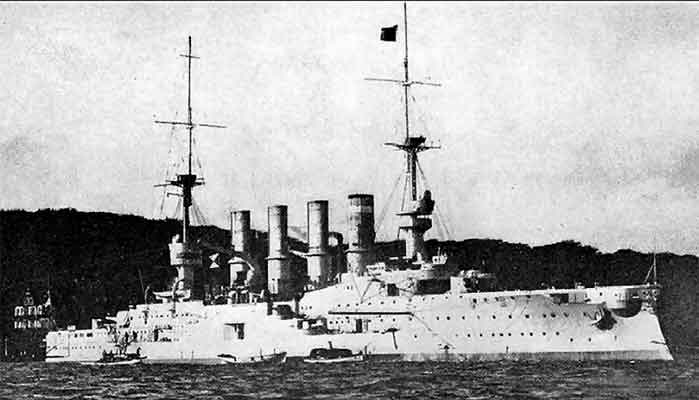 |
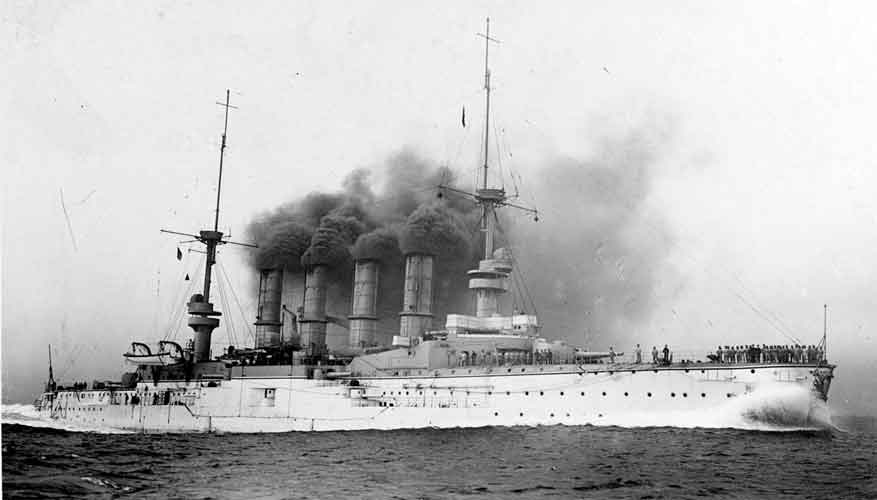
| Scharnhorst | Gneisenau |
The Battle of Coronel was effective Monmouth and Good Hope against Scharnhorst and Gneisenau. Or 2 nine inch guns on the British side mounted on slow ships against 8 eight inch guns mounted on the faster German ships with better trained gunnery crew. The odds were stacked against the British, and the British lost
With hindsight it is difficult to say whether it was bad communication between London and Cradock, or whether the Royal Navy really believed that they were invincible, no matter how big the difference in fire power with the other side.
The result today is that the remains of two British warships lie on the ocean bottom off the coast of Chile with the bones of some 1600 sailors
Back to the Explorer and our voyage